IoT Spy Device
The Smartwatch CTF - Unraveling an IoT Spy Device
Akhil, a cybersecurity researcher, receives an unusual request from a friend: “I think my smartwatch is spying on me. Can you check it out?ˮ Intrigued, Akhil accepts the challenge.
Little does he know, this investigation will turn into a full-fledged security audit, revealing a hidden threat disguised as an innocent fitness tracker.
Phase 1:
Reconnaissance & OSINT
Before tearing apart the smartwatch, Akhil gathers Open-Source Intelligence (OSINT) to learn about its internals.
Tasks:
- Identify the Manufacturer & Model – Checking the FCC ID reveals the manufacturer and certification details.
- Analyze Online Documentation – Searching for datasheets, teardown videos, and known vulnerabilities.
- Component Identification – Determining the CPU, Bluetooth module, and storage type based on OSINT findings.
Key Concepts:
- FCC ID Lookup – Helps identify internal schematics and chipsets.
- Chipset Analysis – Determines if the smartwatch runs on ARM Cortex, RISC-V, or a proprietary system.
- Bluetooth Security – Investigates if the device is using insecure Bluetooth pairing, exposing it to attacks.
Phase 2:
Hardware Inspection & Debugging
Akhil carefully disassembles the smartwatch, searching for debugging interfaces.
Tasks:
- Locate Debugging Ports – Finding exposed UART, JTAG, or SWD interfaces.
- Connect to UART/JTAG – Establishing communication with a debugging tool.
- Dump the Firmware – Extracting the firmware for analysis.
Tools & Techniques:
- Multimeter & Oscilloscope – Helps trace active pins and voltage levels.
- USB-to-UART Adapter (e.g., CP2102, FTDI) – Enables interaction with serial consoles.
- JTAGulator – Auto-detects JTAG pinouts.
- Flashrom – Reads firmware from onboard flash memory.
Debugging Interfaces:
- UART (Universal Asynchronous Receiver-Transmitter) – Often provides a serial console.
- JTAG (Joint Test Action Group) – Grants deep debugging capabilities.
- SWD (Serial Wire Debug) – ARM-specific debugging alternative.
Phase 3:
Firmware Extraction & Static Analysis
With a successful firmware dump, Akhil examines its contents.
Tasks:
- Extract Filesystem & Binaries – Identifying and extracting crucial files.
- Analyze Strings & Configuration Files – Searching for hardcoded credentials and API endpoints.
- Identify Network Activity – Detecting suspicious outbound connections.
Tools:
- Binwalk – Extracts and analyzes firmware images.
- Strings – Searches for readable text within binaries.
- Ghidra / IDA Pro – Reverse engineering tools.
- Radare2 – A lightweight alternative for binary analysis.
Example Commands:

Suspicious Findings:
While analyzing the extracted files, Akhil stumbles upon a hardcoded URL pointing to an external server in China. Running strings on one of the binaries reveals the following:

This confirms the device is transmitting user data without consent.
Phase 4:
Behavioral Analysis & Network Monitoring
Akhil sets up a controlled environment to monitor the smartwatchʼs real-time behavior.
Tasks:
- Monitor Network Traffic – Capturing packets to inspect data transmission.
- Analyze Companion App – Checking for unnecessary permissions.
- Emulate the Firmware – Running the firmware in aed environment.
Tools:
- Wireshark – Captures and analyzes network packets.
- Mitmproxy – Intercepts and modifies HTTP/S traffic.
- Frida – Hooks into the smartwatch app for deeper analysis.
- QEMU – Emulates the smartwatchʼs firmware.
Packet Capture Output:
Akhil records outgoing network traffic and finds the following log snippet:
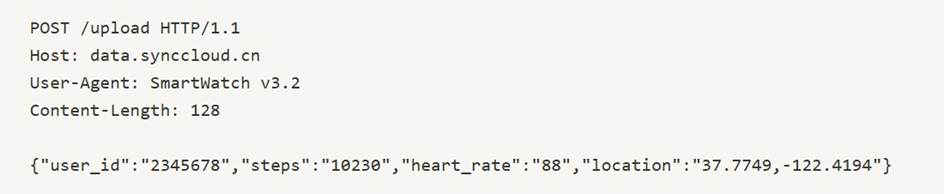
This confirms the watch is secretly sending user data to a remote server.
Phase 5:
Exploitation & Mitigation
Having identified security flaws, Akhil attempts to exploit them.
Tasks:
- Privilege Escalation – Searching for ways to gain root access.
- Firmware Patching – Modifying the firmware to disable tracking.
- Mobile Infection Risks – Determining if the app can inject malware.
Exploitation Techniques:
- Backdoor Access via UART/JTAG – Hardcoded root credentials allow system takeover.
- Insecure API Endpoints – Weak authentication permits unauthorized data extraction.
- Malware Injection via App Permissions – Excessive permissions create attack vectors.
Attempting a Root Shell:
Akhil connects to the UART interface and logs into the smartwatchʼs shell:

Bingo! The device has a weakly protected root account.
Lesson
Akhilʼs investigation highlights the dangers of insecure IoT devices. His research unveiled security threats which were exposing the userʼs data.
If a smartwatch can spy on you, what about other smart devices you own?
Question 1.
What method did Akhil use to identify the smartwatch manufacturer?
Question 2.
Which open-source tool extracts firmware from binary images?
Question 3.
What type of debugging port provides serial console access?
Question 4.
Which tool is used to intercept and modify HTTPS traffic?
Question 5.
Which reverse engineering tool is developed by the NSA?
Question 6.
Which file contains stored user credentials on Linux-based systems?
Question 7.
Which hardware debugging protocol is specific to ARM processors?
Question 8.
What command extracts readable text from binaries?
Question 9.
Which network analysis tool captures and inspects packets?
Question 10.
Which software can emulate embedded systems like smartwatches?
Question 11.
Which technique involves searching for datasheets, forums, and online teardown reports?
Question 12.
Which tool can auto-detect JTAG pinouts on a circuit board?
Question 13.
Which programming language is primarily used for writing exploit scripts in cybersecurity?
Question 14.
Which country was the suspicious smartwatch server located in?
Question 15.
Which command lists files and directories in a Linux shell?
Question 16.
Which attack vector involves unauthorized data transmission over Bluetooth?
Question 17.
Which hardware tool is used to read firmware directly from flash memory?
Question 18.
Which privilege level did Akhil escalate to on the smartwatch?
Question 19.
What authentication flaw did Akhil discover in the smartwatch API?
Question 20.
Which Linux command did Akhil use to interact with the smartwatch via UART?
Question 21.
What is the API key uncovered in the firmware analysis?
Question 22.
What is the host uncovered from the packet capture?