
System Hacking
Foundations of System Hacking

Overview
System hacking refers to the process of identifying vulnerabilities and exploiting weaknesses within operating systems, authentication mechanisms, applications, or user configurations to gain unauthorized access to computer systems.
Threat actors commonly target weak passwords, outdated software, insecure services, and improperly configured user permissions to compromise enterprise infrastructure.
Once access is obtained, malicious actors may escalate privileges, maintain persistence, extract credentials, and hide traces of their activities to avoid detection.
Understanding the techniques and phases involved in system hacking allows cybersecurity professionals to strengthen organizational defenses and identify security weaknesses before attackers exploit them in real-world environments.
Learning Objectives
Upon completion of this module, learners will understand:
- The concept of system hacking
- The different phases involved in system compromise
- Privilege escalation techniques
- Persistence mechanisms
- Common attacker objectives in enterprise environments
System Hacking Attack Flow
↓
Scanning & Enumeration
↓
Gaining Access
↓
Privilege Escalation
↓
Maintaining Access
↓
Covering Tracks
Understanding System Hacking Phases
Reconnaissance
Reconnaissance is the initial phase where attackers gather information about target systems, users, services, and network infrastructure.
Information collected during this stage helps attackers identify vulnerabilities and prepare attack strategies.
Scanning & Enumeration
Attackers use scanning techniques to discover live hosts, open ports, running services, and system configurations.
Enumeration provides deeper insights into users, shares, policies, and authentication services available on the target system.
Privilege Escalation
After initial access is achieved, attackers attempt to elevate their privileges to administrative or root-level permissions.
This phase allows greater control over the compromised system and access to sensitive resources.
Maintaining Access
Persistence mechanisms are deployed to maintain long-term access to systems.
Attackers may create hidden accounts, scheduled tasks, malicious services, or backdoors to reconnect later without repeating the initial compromise.
Covering Tracks
Attackers attempt to remove logs, modify timestamps, or delete evidence to avoid detection by administrators and security monitoring systems.
Security Insight
Weak passwords and excessive administrative privileges remain among the most common causes of enterprise system compromise.
An attacker gains unauthorized administrator access. Is this system hacking?
Which phase occurs before exploitation?
Privilege escalation increases user permissions.
Which activity removes evidence after compromise?
Ethical hackers require authorization.
Which attack phase maintains long-term access?
An attacker scans open ports before attacking. Which phase is this?
Which account usually has the highest privileges in Windows?
System hacking only targets servers.
Which item is commonly targeted during credential attacks?
Which issue allows exploitation of outdated systems?
A malicious actor deletes logs after intrusion. What is this called?
Windows System Hardening & Defensive Security

Overview
Windows operating systems are among the most widely used enterprise platforms and therefore remain a primary target for cyberattacks.
Threat actors commonly exploit weak authentication policies, exposed services, outdated software, and insecure configurations to compromise systems.
Effective Windows hardening reduces attack surfaces and improves resistance against unauthorized access attempts.
Organizations implement layered security controls such as firewalls, endpoint protection, patch management, access restrictions, and security monitoring solutions to defend enterprise assets.
Strong security practices and proper configuration management play a critical role in protecting systems against modern cyber threats.
Learning Objectives
Upon completion of this module, learners will understand:
- Windows hardening concepts
- Common defensive controls
- Secure authentication practices
- Least privilege principles
- The importance of patch management and system monitoring
Windows Defensive Security Architecture
↓
Access Controls
↓
Multi-Factor Authentication
↓
Windows Firewall
↓
Antivirus Protection
↓
Patch Management
↓
Security Logging
Windows Security Controls
Windows Firewall
Windows Firewall filters inbound and outbound network traffic to block unauthorized connections and restrict suspicious communication attempts.
Multi-Factor Authentication
Multi-factor authentication adds an additional layer of verification beyond passwords, significantly reducing the risk of unauthorized access.
Patch Management
Regular security updates help eliminate known vulnerabilities and reduce exposure to publicly available exploits.
Least Privilege Principle
Users should only receive permissions necessary to perform their job functions.
Restricting administrative privileges minimizes attack impact.
Security Monitoring
Event logs and monitoring systems help administrators identify suspicious activity, failed login attempts, and potential compromise indicators.
Security Insight
Organizations with poor patch management practices face significantly higher risks of ransomware and credential compromise attacks.
Which Windows feature filters unauthorized network traffic?
Which process fixes outdated vulnerabilities?
Users should always have administrator privileges.
Which software detects malicious files on systems?
Administrators review suspicious login attempts in which component?
Which policy enforces password complexity requirements?
Which principle restricts unnecessary permissions?
Disabling security updates increases risk.
Which Windows utility stores security events?
Which authentication method requires multiple verification steps?
What should administrators disable to reduce attack surfaces?
LM, NTLM & KERBEROS Authentication Security
Overview
Authentication protocols are essential components of Windows security architecture and enterprise identity management.
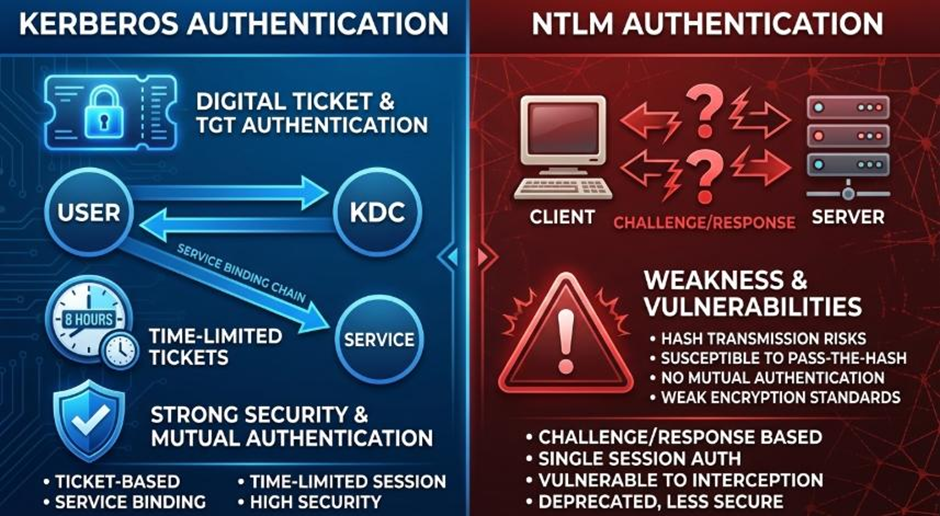
Legacy authentication methods such as LM are considered insecure because of weak hashing mechanisms that are vulnerable to cracking attacks.
NTLM introduced improved authentication security but remains vulnerable to attacks such as pass-the-hash and credential relay attacks.
Kerberos is the preferred enterprise authentication protocol due to its ticket-based authentication model and encrypted communication mechanisms within Active Directory environments.
Understanding how these protocols operate, where credentials are stored, and how attackers abuse them is critical for cybersecurity professionals involved in defensive security operations.
Learning Objectives
Upon completion of this module, learners will understand:
- LM authentication mechanisms
- NTLM authentication mechanisms
- Kerberos authentication mechanisms
- Credential storage locations
- Pass-the-hash attacks
- Enterprise authentication security risks
Authentication Evolution Timeline
↓
NTLM Authentication
↓
NTLMv2 Improvements
↓
Kerberos Authentication
Authentication Protocol Comparison
| Protocol | Security Level | Enterprise Usage | Common Weakness |
|---|---|---|---|
| LM | Very Weak | Legacy Systems | Easily cracked |
| NTLM | Moderate | Windows Authentication | Pass-the-Hash |
| Kerberos | Strong | Active Directory | Ticket abuse |
Credential Storage Locations
| Component | Purpose |
|---|---|
| SAM Database | Stores local account password hashes |
| Active Directory | Centralized enterprise authentication |
| LSASS Process | Handles active authentication sessions |
Understanding Authentication Security
LM Authentication
LM authentication is an outdated protocol that stores weak password hashes.
Due to limited password complexity and insecure hashing algorithms, LM hashes are highly vulnerable to cracking attacks.
NTLM Authentication
NTLM uses a challenge-response authentication mechanism to verify user credentials.
Threat actors frequently abuse NTLM hashes during lateral movement activities within enterprise environments.
Kerberos Authentication
Kerberos uses encrypted tickets instead of direct password transmission.
It is the default authentication protocol used in modern Active Directory enterprise environments.
Security Insight
Credential dumping attacks frequently target LSASS memory to extract NTLM hashes and Kerberos tickets from compromised systems.
Which authentication protocol uses tickets?
NTLM replaced LM authentication.
Which database stores local password hashes?
Which protocol is preferred in Active Directory environments?
Which attack uses NTLM hashes without cracking them?
Kerberos reduces password exposure over networks.
Which process handles authentication sessions in Windows?
Which authentication method uses challenge-response verification?
Which authentication protocol should be disabled in modern environments?
A Ticket Granting Ticket belongs to which protocol?
Credential dumping commonly targets which Windows process?
Practical Password Auditing & Hash Security Lab
Overview
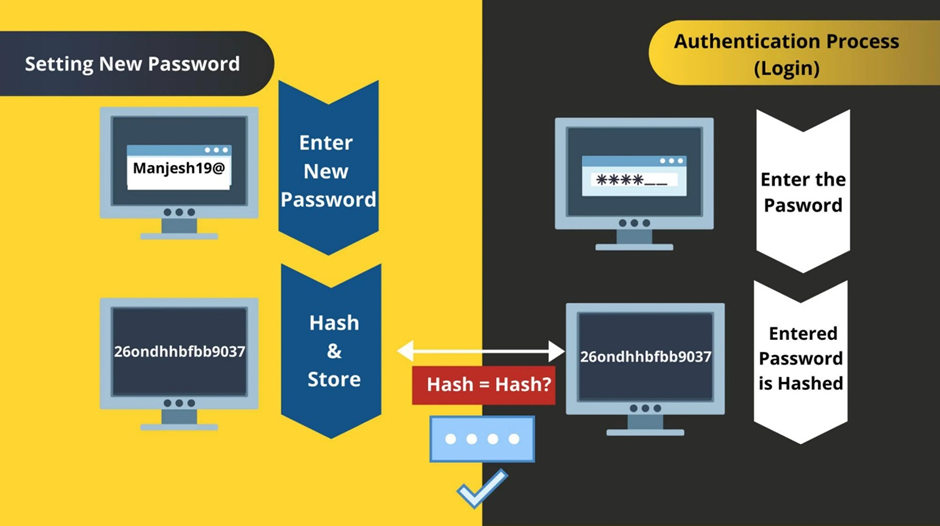
Password auditing and hash analysis are essential activities performed during security assessments and defensive security operations.
Weak passwords significantly increase organizational exposure to unauthorized access and credential compromise attacks.
In controlled cybersecurity laboratories, security professionals analyze password strength and authentication security using different password auditing techniques.
Common methods include dictionary attacks, brute-force attacks, rule-based modifications, and hybrid attack strategies.
This module introduces learners to password hash analysis concepts using LM, NTLM, and Kerberos hash samples within isolated educational environments.
Learning Objectives
Upon completion of this module, learners will understand:
- Password auditing concepts
- Common password attack methods
- Weak credential patterns
- The importance of strong password policies
Password Auditing Workflow
↓
Hash Identification
↓
Wordlist Selection
↓
Cracking Technique
↓
Password Recovery
↓
Security Assessment
Password Attack Techniques
Dictionary Attack
Dictionary attacks use predefined wordlists containing commonly used passwords and predictable patterns.
Brute-Force Attack
Brute-force attacks systematically attempt all possible combinations until the correct password is discovered.
Rule-Based Attack
Rule-based attacks modify existing words using patterns, symbols, or character substitutions to improve cracking success rates.
Hybrid Attack
Hybrid attacks combine dictionary words with additional characters, numbers, or patterns.
Security Insight
Password complexity, length, symbols, and unpredictability significantly increase resistance against cracking attacks.
Practical Hash Collection
LM Hashes
E52CAC67419A9A224A3B108F3FA6CB6D
44EFCE164AB921C0AAD3B435B51404EE
B757BF5C0D87772FAAD3B435B51404EE
NTLM Hashes
32ED87BDB5FDC5E9CBA88547376818D4
B4B9B02E6F09A9BD760F388B67351E2B
5F4DCC3B5AA765D61D8327DEB882CF99
25D55AD283AA400AF464C76D713C07AD
31D6CFE0D16AE931B73C59D7E0C089C0
Kerberos Hashes
$krb5tgs$23$*backup$LAB.LOCAL$MSSQLSvc/sql01*$hashdata
[email protected]:hashdata
$krb5tgs$18$*service$CORP.LOCAL$cifs/fileserver*$hashdata
$krb5tgs$23$*sqladmin$ENTERPRISE.LOCAL$MSSQLSvc/db01*$hashdata
Additional Challenge Hashes
5D41402ABC4B2A76B9719D911017C592
7C6A180B36896A0A8C02787EEAFB0E4C
6CB75F652A9B52798EB6CF2201057C73
482C811DA5D5B4BC6D497FFA98491E38
E10ADC3949BA59ABBE56E057F20F883E
Which tool commonly uses GPU acceleration for password cracking?
Which attack uses predefined wordlists?
Which attack tries all possible combinations?
Hash cracking should only occur in authorized environments.
Which attack modifies existing words using patterns and symbols?
Which attack combines words with patterns?
Which password characteristic increases cracking difficulty?
Which Linux-based tool is widely used for password auditing?
LM hashes are easier to crack than NTLM hashes.
What type of value represents transformed password data?
Which environment should be used for password auditing practice?