
Footprinting
Introduction to Footprinting
Introduction to Footprinting
Learn how ethical hackers and attackers gather information about organizations, systems, domains, employees, and technologies before launching security assessments or cyberattacks.

What is Footprinting?
The first stage of cybersecurity reconnaissance
Footprinting is the process of collecting information about a target system, organization, network, or individual before performing an attack or security assessment.
It is considered the first phase of ethical hacking and reconnaissance.
The main purpose of footprinting is to gather as much information as possible about the target environment. Attackers use this information to identify weaknesses, understand the infrastructure, and prepare for further attacks.
In cybersecurity, footprinting helps security professionals understand what information about an organization is publicly exposed and how attackers may use it.
Objectives of Footprinting
Information gathered during reconnaissance

- 🏢 Collect organization information and public company footprint.
- 🌍 Identify IP ranges & domains linked to the target infrastructure.
- 📧 Gather employee emails and identity-related data exposed online.
- 💻 Discover technologies & OS used in web, server, and network layers.
- ⚠ Detect security weaknesses before active testing begins.
- 🛰 Understand network topology and service exposure paths.
- 🌐 Discover DNS information including records, hosts, and subdomains.
- 🔓 Prepare for exploitation with validated reconnaissance intelligence.
Types of Footprinting
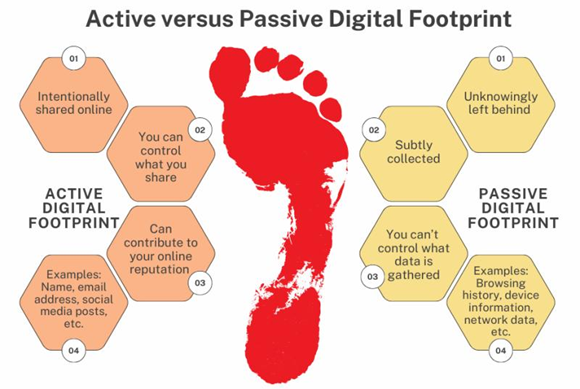
Cyber reconnaissance is commonly divided into passive and active techniques based on attacker interaction with the target.
Passive Footprinting
No direct interaction with target systems
Passive footprinting is the process of collecting information about the target without directly interacting with the target systems.
In passive footprinting, the attacker gathers information from publicly available sources such as search engines, social media platforms, public records, and online databases.
Since there is no direct interaction with the target, passive footprinting is difficult to detect.
📂 Information Gathered in Passive Footprinting
- 🏢 Company Details
- 📧 Employee names and emails
- 🌍 DNS Records
- 📱 Social Media
- 💻 Website Technologies
- 📄 Metadata & Documents
Advantages
- Difficult to detect
- Safe reconnaissance method
- No direct connection to target
- Large amount of public information
Disadvantages
- Information may be outdated
- Limited technical details
- Cannot verify live systems
Active Footprinting
Direct interaction with target systems
Active footprinting is the process of gathering information by directly interacting with the target system or network.
In this method, the attacker sends requests to the target to collect information about live hosts, services, operating systems, and network structure.
Unlike passive footprinting, active footprinting can often be detected by security monitoring systems.
🔍 Information Gathered in Active Footprinting
- 🌐 Live Hosts
- 🔓 Open Ports
- 💻 Running Services
- 🛰 Network Topology
- 🛡 Firewall Rules
- ⚙ Operating Systems
Advantages
- Provides accurate information
- Identifies live systems
- Maps network infrastructure
- Reveals technical details
Disadvantages
- Easier to detect
- May trigger security alerts
- Can be blocked by IDS/IPS systems
Which type of footprinting interacts directly with the target?
Is passive footprinting difficult to detect?
What is the first phase of ethical hacking?
True or False: Active footprinting uses direct communication.
Which footprinting type uses search engines and social media?
Can active footprinting trigger IDS alerts?
Which information helps identify mail servers?
True or False: Passive footprinting confirms live systems.
Which footprinting type reveals technical details?
What is collected before exploitation begins?
Which footprinting type is safer for reconnaissance?
True or False: Footprinting helps understand network topology.
Threats Arising from Footprinting
🛡 Threats Arising from Footprinting

🎯 Introduction
Information collected during footprinting can be used by attackers to perform different types of cyber attacks against an organization. Even small pieces of publicly available information can help attackers understand the target environment and identify weaknesses.
Attackers combine collected data to prepare advanced attacks such as phishing, social engineering, network intrusion, password attacks, and exploitation of vulnerable services.
⚠ Common Threats from Footprinting
🧠 Social Engineering Attacks
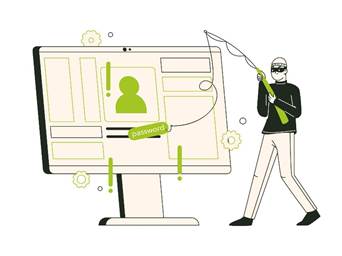
One of the biggest threats arising from footprinting is social engineering.
Attackers gather:
- 👤Employee names
- 📧Email addresses
- 📱Phone numbers
- 🧾Job roles
- 🌐Social media information
This information is used to trick employees into revealing sensitive information or performing unauthorized actions.
Examples:
- ✉Phishing emails
- 📞Fake IT support calls
- 👔CEO fraud
- 🎭Impersonation attacks
- 🔑Credential harvesting
🧪 Example Scenario: An attacker collects employee details from LinkedIn and sends a fake password reset email pretending to be the IT department.
🌐 System and Network Attacks

Footprinting helps attackers identify technical details about systems and networks.
Information such as:
- 📍IP addresses
- 🔓Open ports
- ⚙Operating systems
- 🧭DNS records
- 🛰Network ranges
- 🖥Running services
These details can be used to launch attacks against infrastructure.
🔐 Password Attacks
Collected usernames and email addresses may be used in:
- 💥Brute force attacks
- 🎯Password spraying
- ♻Credential stuffing
🗺 Network Mapping
Attackers may create a map of the network infrastructure to identify:
- 🏛Critical servers
- 🛡Firewalls
- 📡Routers
- 🏢Internal systems
🦠 Malware and Ransomware Delivery

Footprinting information helps attackers craft targeted malware campaigns.
Examples:
- 📎Sending malicious attachments to employees
- 🎯Targeting vulnerable systems discovered during reconnaissance
🕸 Website and Web Application Threats
Footprinting also helps attackers identify:
- 🧩Website technologies
- 📰CMS platforms
- 🏗Frameworks
- 🔌Plugins
- 🛠Admin panels
This information can be used to exploit:
- 💉SQL Injection vulnerabilities
- 🧨Remote Code Execution vulnerabilities
- 📤File upload vulnerabilities
- 🔐Authentication weaknesses
Which attack tricks users into revealing information ?
True or False: Footprinting can help ransomware attacks.
Which attack uses stolen credentials on multiple accounts ?
Which attack sends fake emails to victims ?
What type of information reveals open ports and services ?
True or False: Attackers use LinkedIn for reconnaissance.
Which attack attempts many passwords against accounts ?
Which systems protect against suspicious scanning activity ?
Can footprinting identify vulnerable services?
What type of attack targets website vulnerabilities ?
True or False: Network mapping identifies critical servers.
Which information source reveals employee job roles ?
CLI Based Footprinting Tools
⌨ CLI Based Footprinting Tools
🎯 Introduction
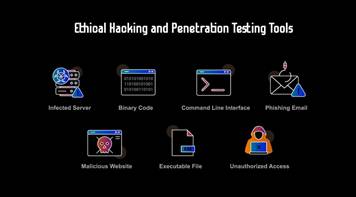
Command Line Interface (CLI) tools are commonly used in footprinting because they are fast, lightweight, and powerful. These tools help security professionals gather technical information directly from the terminal.
🌐 WHOIS
Purpose: Gather domain registration details.
Information Gathered:
- Domain owner
- Registrar
- Registration date
- Expiry date
- Name servers
🧭 NSLOOKUP
Purpose: Query DNS information.
Information Gathered:
- IP addresses
- DNS records
- Mail server details
🔎 DIG
Purpose: Advanced DNS lookup utility.
📧 theHarvester
Purpose: Gather emails, subdomains, and employee information.
🧩 DNSENUM
Purpose: Perform DNS enumeration.
🛰 Nmap
Purpose: Network discovery and port scanning.
🕸 WhatWeb
Purpose: Website technology fingerprinting.
🛣 Traceroute
Purpose: Identify packet route to target.
🌍 Sublist3r
Purpose: Subdomain enumeration.
✅ Benefits of CLI Tools
- Faster execution
- Better automation
- Suitable for scripting
- Lightweight and efficient
- Preferred by penetration testers
❌ Disadvantages of CLI Tools
- Requires command-line knowledge
- Difficult for beginners to learn
- Higher chance of typing errors
- Limited graphical visualization
- Manual report generation needed
Which tool performs port scanning ?
Which command gathers domain registration details ?
True or False: CLI tools are lightweight.
Which tool is used for DNS queries ?
Which tool identifies website technologies ?
Which tool gathers employee emails and subdomains ?
True or False: CLI tools provide graphical visualization.
Which tool traces packet routes to a target ?
Which tool performs DNS enumeration ?
Can typing mistakes affect CLI commands ?
Which tool discovers subdomains ?
True or False: CLI tools are preferred for automation.
GUI Based Footprinting Tools
🧰 GUI Based Footprinting Tools

🎯 Introduction
GUI (Graphical User Interface) tools provide a visual and user-friendly method for performing reconnaissance and footprinting activities. These tools help security professionals analyze information more efficiently through graphs, dashboards, and visual mapping.
🕸 Maltego
Purpose: Intelligence gathering and relationship mapping.
Features:
- Domain mapping
- Email tracking
- Social media analysis
- Infrastructure visualization
- Relationship analysis
Information Gathered:
- Domains
- IP addresses
- Employee details
- Email addresses
- Public records
📄 FOCA
Purpose: Metadata analysis and document footprinting.
Features:
- Extracts metadata from documents
- Identifies usernames
- Finds software versions
- Detects internal paths
Supported Documents:
- DOCX
- XLSX
- PPTX
🕷 SpiderFoot
Purpose: Automated OSINT and reconnaissance platform.
Features:
- Automated scanning
- Threat intelligence integration
- Subdomain discovery
- Data correlation
🧩 Recon-ng
Purpose: Framework for automated reconnaissance.
Features:
- Modular architecture
- API integration
- Automated information gathering
- Reporting support
🔎 Shodan
Purpose: Search engine for internet-connected devices.
Features:
- Device discovery
- Service identification
- Banner information
- Vulnerability exposure analysis
🌐 Censys
Purpose: Internet-wide asset discovery platform.
Features:
- Certificate analysis
- Host discovery
- Service enumeration
- Internet exposure monitoring
🧠 Google Dorking
Purpose: Gather publicly available sensitive information from search engines.
Features:
- Finds exposed sensitive documents
- Discovers login and admin pages
- Identifies publicly accessible directories
- Searches specific websites and file types
- Helps in reconnaissance and information gathering
✅ Advantages of GUI Tools
- Easy to use
- Better visualization
- Simplified analysis
- Suitable for beginners
- Centralized information management
❌ Disadvantages of GUI Tools
- Higher resource usage
- Slower than CLI tools
- Limited automation in some tools
- May require paid licenses
Which GUI tool is used for relationship mapping ?
Which tool extracts document metadata ?
True or False: GUI tools provide better visualization.
Which tool is known as a search engine for devices ?
Which platform performs automated OSINT scanning ?
Which tool supports modular reconnaissance ?
True or False: GUI tools are easier for beginners.
Which technique uses advanced Google search operators ?
Which tool performs internet-wide asset discovery ?
Can Google Dorking find exposed documents ?
True or False: GUI tools may require paid licenses.
Which GUI tool helps identify internal file paths ?