Cloud Computing
Introduction to Cloud Computing
Introduction to Cloud Computing
What is Cloud Computing?
Cloud computing is the delivery of computing services such as servers, storage, databases, networking, software, analytics, and intelligence over the internet.
Instead of owning and maintaining physical infrastructure, organizations can access these resources on demand from cloud service providers.
Key Features
- Eliminates the need for physical hardware infrastructure
- Provides on-demand computing resources
- Supports scalability and flexibility
- Reduces operational and infrastructure costs
- Enables remote accessibility through the internet
Problem Solved by Cloud Computing
Traditional Infrastructure (On-Premises Model)
Before cloud computing, organizations had to manage everything internally.
Challenges of the Old Model
- Purchase of physical servers and networking equipment
- High Capital Expenditure (CapEx)
- Long deployment and setup time
- Overprovisioning of resources
- Complex maintenance and upgrades
- Limited scalability
Modern Cloud-Based Approach
Cloud computing replaced the traditional infrastructure model with a service-based approach.
Benefits of the Cloud Model
- Resources are rented instead of purchased
- Pay-as-you-go pricing model
- Instant resource provisioning
- Better scalability and flexibility
- Reduced hardware maintenance
- Improved resource utilization
What type of expenditure is reduced in cloud computing?
Cloud computing requires organizations to always purchase physical servers.
Which model allows users to pay only for the resources they use?
A startup wants to deploy an application quickly without buying hardware. Which technology should they use?
What is the traditional infrastructure model called?
Cloud computing helps reduce resource wastage.
Which major benefit allows instant provisioning of resources?
A company spends too much time configuring physical servers manually. Which solution can improve efficiency?
Cloud Computing Architecture & Characteristics
Cloud Computing Architecture & Characteristics
Cloud Computing Architecture
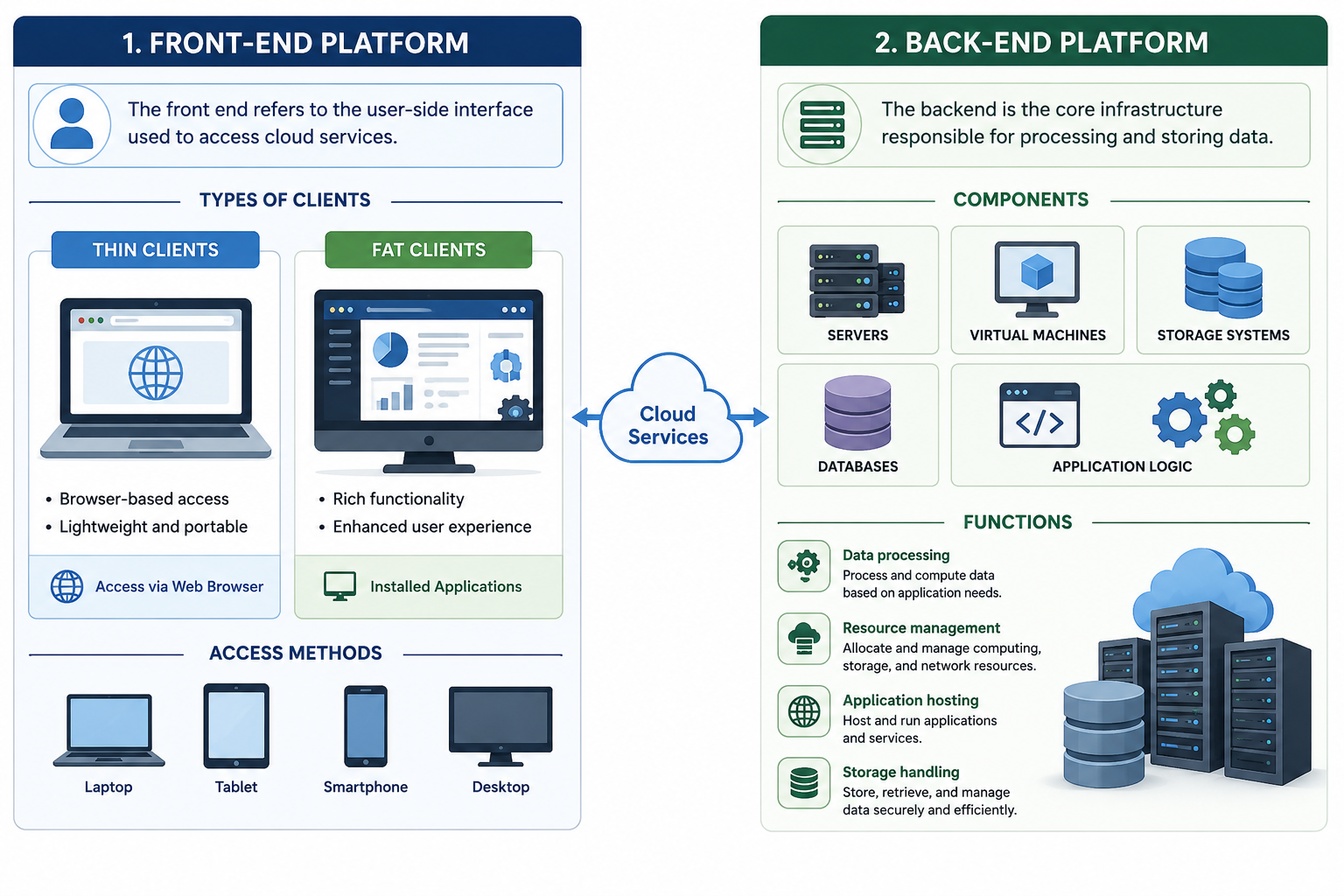
Cloud computing architecture consists of multiple interconnected components that work together to provide cloud services.
Main Components
1. Front-End Platform
The front end refers to the user-side interface used to access cloud services.
Types of Clients
- Thin Clients
- Browser-based access
- Lightweight and portable
- Fat Clients
- Rich functionality
- Enhanced user experience
2. Back-End Platform
The backend is the core infrastructure responsible for processing and storing data.
Components
- Servers
- Virtual Machines
- Storage Systems
- Databases
- Application Logic
Functions
- Data processing
- Resource management
- Application hosting
- Storage handling
3. Cloud-Based Delivery Network
Cloud services are delivered using different networking models.
Types of Networks
- Internet
- Global accessibility
- Intranet
- Internal organizational communication
- Intercloud
- Communication between multiple cloud providers
Characteristics of Cloud Computing
Cloud computing follows five essential characteristics.
1. On-Demand Self-Service
Users can provision resources automatically without human interaction from the provider.
2. Broad Network Access
Cloud services can be accessed from:
- Laptops
- Smartphones
- Tablets
- Desktop systems
3. Resource Pooling
Resources are shared among multiple users using a multi-tenant architecture.
4. Rapid Elasticity
Resources can scale up or down automatically depending on workload demands.
5. Measured Service
Cloud follows a pay-as-you-use billing model with monitored resource consumption.
Which part of cloud architecture interacts directly with users?
Thin clients mainly depend on web browsers.
Which backend component stores and processes data?
What network provides global cloud accessibility?
Which cloud characteristic allows automatic scaling?
Resource pooling supports multi-tenant environments.
Which cloud feature measures and monitors resource usage?
A user accesses cloud services from a smartphone and laptop. Which characteristic supports this?
Cloud Service Models
Cloud Service Models
1. Infrastructure as a Service (IaaS)
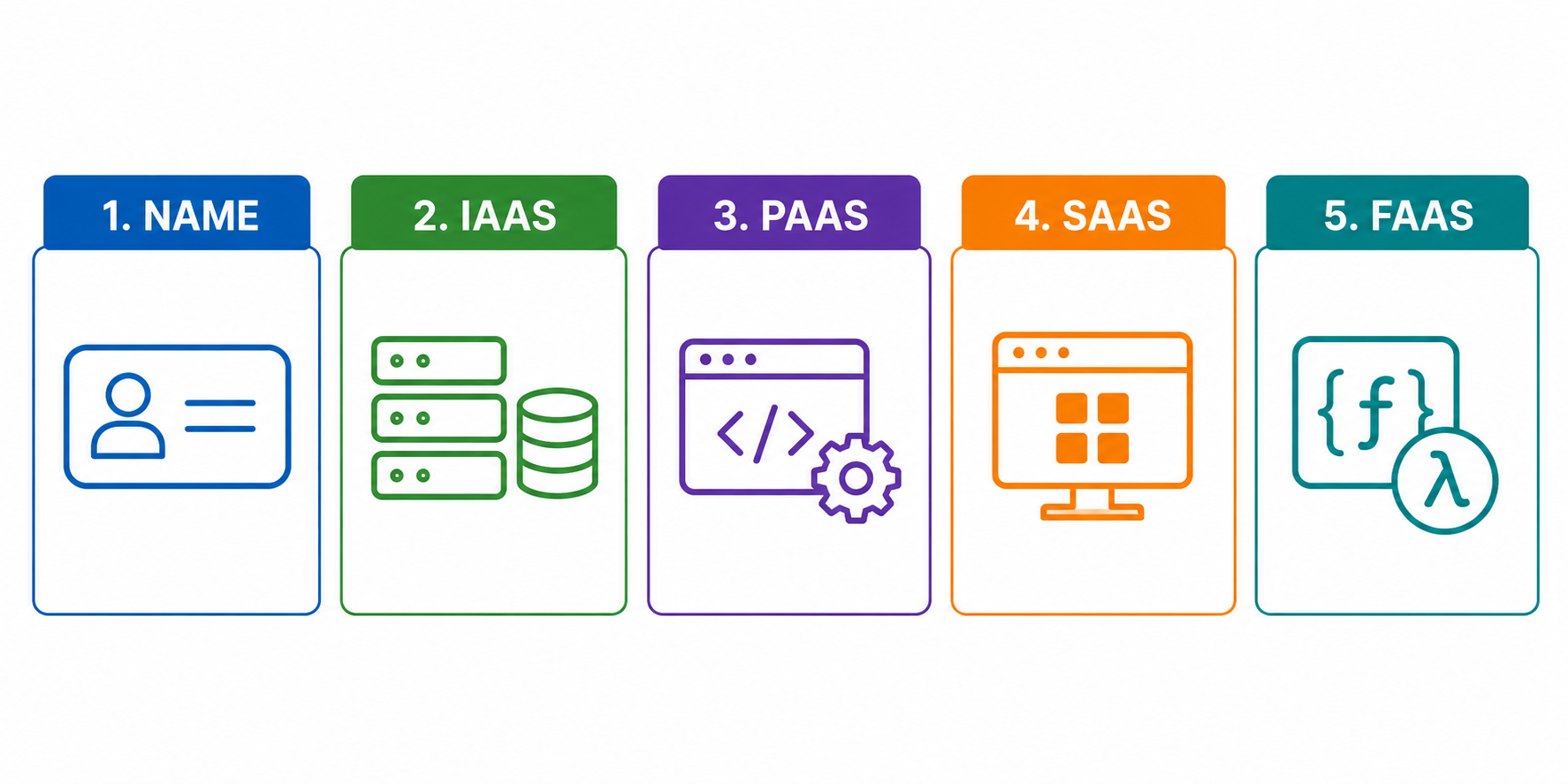
IaaS provides virtualized computing resources over the internet.
Services Offered
- Virtual Machines
- Storage
- Networking
- Load Balancers
Advantages
- High flexibility and control
- Reduced hardware investment
- Easy scalability
- Cost-effective infrastructure management
Example Providers
- AWS EC2
- Microsoft Azure Virtual Machines
- Google Compute Engine
2. Platform as a Service (PaaS)
PaaS provides a complete platform for application development and deployment.
Features
- Application hosting
- Development frameworks
- Database management
- Automated scaling
Advantages
- Simplified development process
- Faster deployment
- Reduced infrastructure complexity
- Improved productivity
Example
- AWS Elastic Beanstalk
3. Software as a Service (SaaS)
SaaS delivers software applications over the internet.
Features
- Browser-based access
- No local installation required
- Automatic updates
- Centralized management
Advantages
- Easy accessibility
- Better collaboration
- Reduced maintenance
- Lower software costs
Example
- Google Docs
4. Function as a Service (FaaS)
FaaS allows developers to execute code in response to events without managing servers.
Features
- Event-driven execution
- Serverless architecture
- Automatic scaling
- Pay-per-execution model
Advantages
- Reduced infrastructure management
- High scalability
- Cost optimization
- Faster deployment cycles
Example
- AWS Lambda
Which cloud model provides virtual machines and networking?
SaaS applications usually require local installation.
Which service model focuses mainly on application development?
Which AWS service is an example of FaaS?
A developer wants AWS to manage servers while focusing only on coding. Which service model is suitable?
Which service model delivers software over the internet?
FaaS follows an event-driven execution model.
Which cloud service model provides the highest infrastructure control?
Deployment Models & Cloud Providers
Deployment Models & Cloud Providers
Cloud Deployment Models
1. Private Cloud
Infrastructure dedicated to a single organization.
Features
- High security
- Greater control
- Custom configurations
2. Public Cloud
Cloud services provided over the public internet by third-party providers.
Features
- Massive scalability
- Cost efficiency
- Pay-as-you-go model
3. Hybrid Cloud
Combination of private and public cloud environments.
Features
- Improved flexibility
- Better workload distribution
- Secure handling of sensitive data
4. Multi-Cloud
Use of multiple cloud providers simultaneously.
Benefits
- Avoids vendor lock-in
- Improves reliability
- Best-service selection from multiple providers
Top Cloud Computing Companies
| Company | Cloud Platform | Key Services |
|---|---|---|
| Amazon | AWS | Compute, Storage, AI/ML, Networking |
| Microsoft | Azure | Hybrid Cloud, AI, Analytics |
| GCP | Big Data, Kubernetes, AI/ML | |
| Alibaba | Alibaba Cloud | CDN, AI, Security |
| Oracle | Oracle Cloud | Databases, Enterprise Applications |
| IBM | IBM Cloud | Hybrid Cloud, Quantum Computing |
| Salesforce | Salesforce Cloud | CRM, SaaS |
| Tencent | Tencent Cloud | IoT, Gaming Cloud |
Which deployment model offers the highest security and control?
Public clouds are owned by third-party providers.
Which deployment model combines private and public clouds?
What strategy helps organizations avoid vendor lock-in?
A company stores sensitive data privately but uses AWS for scalability. Which model is this?
Which cloud provider offers Google Cloud Platform?
Which cloud provider is known for AWS?
Multi-cloud uses services from multiple providers.
Cloud Security & Shared Responsibility Model
Cloud Security & Shared Responsibility Model
Shared Responsibility Model
Cloud security is divided between the cloud provider and the customer.
Responsibility of Cloud Providers
Providers secure the infrastructure OF the cloud.
Includes
- Physical data center security
- Hardware maintenance
- Core networking infrastructure
- Hypervisor security
Responsibility of Customers
Customers secure everything IN the cloud.
Includes
- User access management
- Data encryption
- Application security
- Firewall configurations
- Identity and access policies
Cloud Security Best Practices
1. Data Encryption
Protects data from unauthorized access during storage and transmission.
2. Access Control
Restricts access to authorized users only.
Techniques
- Role-Based Access Control (RBAC)
- Identity Management
3. Multi-Factor Authentication (MFA)
Adds an extra verification layer for improved security.
Examples
- OTP Verification
- Biometrics
- Security Tokens
Which security model divides responsibilities between provider and customer?
Customers are responsible for securing applications in the cloud.
Which security technique protects data from unauthorized access?
A company adds OTP verification along with passwords. Which security mechanism is used?
Access control limits unauthorized resource access.
Which security practice controls user permissions?
A customer configures firewall rules and identity policies in AWS. Who is responsible?
Which entity secures physical cloud infrastructure?