zero trust
Zero Trust Security | What is a Zero Trust network?
Daksh KatariaJun 21, 2026
Preparing your workspace...
Loading latest data
Loading article...
Preparing blog content
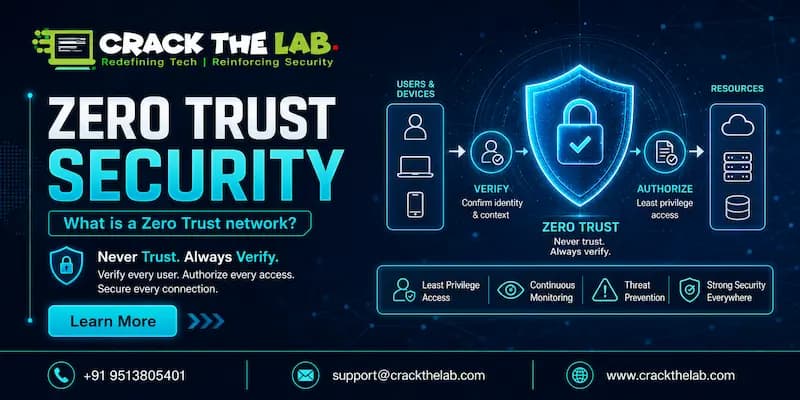
Do you know what Zero Trust Security is, and how it can be beneficial for organizations working in the IT Industry? If not, then you are at the right place. Here, we will talk about “Zero Trust Security” in detail and find out the best way you can improve your cybersecurity skills.
Moreover, we will introduce you to a reliable Catch The Flag platform offered by a reputable VAPT service provider. What are we waiting for? Let’s get straight to the topic!
The modern security paradigm known as "zero trust" is based on the idea of "never trust, always verify," which makes the assumption that dangers can be found both inside and outside the network. By demanding constant authentication and authorization for each user, device, and autonomous AI agent before granting access to certain resources, it does away with the conventional notion of a "trusted" boundary.
Zero Trust makes sure that even if one account is compromised, the attacker cannot move laterally through the system by using least-privilege access and real-time risk assessments. Let’s take a look at what Zero Trust Security is and how it benefits you!
In 2010, Forrester analyst John Kindervag questioned the "trust but verify" paradigm, contending that internal networks ought to be viewed as adversarial as the public internet. This led to the creation of Zero Trust.
With Google's "BeyondCorp" deployment and the 2021 U.S. Executive Order, the idea became a global norm, changing the industry's focus from network perimeter security to individual identity and data security.
|
S.No. |
Principles |
What? |
|
1. |
Continuous Authentication |
Instead of relying on a single "success" at login, it uses behavioral signals to re-verify identification during the whole session. |
|
2. |
Context-Aware Identity |
Analyzes the user's location, device health, time of day, and anomalous activity patterns to assess danger in real-time. |
|
3. |
Strict Least Privilege |
Restricts access to the bare minimum of resources needed for a particular operation, frequently through the use of expiring "Just-in-Time" permissions. |
|
4. |
Assumption of an Internal Threat |
Treats both internal and exterior traffic with equal suspicion, operating under the assumption that the network has already been compromised. |
|
5. |
Explicit Machine & Agent Identity |
Requires each autonomous AI bot and service account to have a distinct, verifiable identity that is subject to the same standards as human users. |
Least Privilege Access guarantees that users and AI agents have only the minimal rights required for their particular duties, while micro-segmentation separates a network into small, isolated zones to stop attackers from migrating laterally.
When combined, they form a "granular perimeter" surrounding each task, greatly lowering the possible explosion radius of a security breach.
Instead of allowing widespread access to the entire network, Zero Trust Network Access (ZTNA) is a security system that offers smooth, encrypted remote access to particular applications based on identification and context.
In contrast to conventional VPNs, ZTNA ensures that every connection is validated and authenticated in real-time before granting access, keeping apps "dark" to unauthorized users and AI agents.
The technique of continuously assessing an identity's risk level and device health during a session, as opposed to simply at the first login, is known as continuous monitoring and verification. When security systems notice suspect activity, such as a change in location or an unauthorized AI agent request, they can immediately restrict access or initiate a re-authentication prompt thanks to this "identity-first" approach.
The following are the benefits of Zero Trust:
1. Minimized Lateral Movement: Ensures that a single compromised account cannot traverse the network to access sensitive data by isolating workloads using micro-segmentation.
2. Drastic Reduction in Data Breach Costs: Compared to perimeter-based models, it saves enterprises an average of $1 million to $4 million each incident by preventing widespread exfiltration.
3. Seamless Support for Hybrid Work: Enables employees and AI agents to work safely from any location or device by substituting identity-centric access for cumbersome VPNs.
4. Continuous Risk Mitigation: Uses real-time behavioral analytics to initiate MFA or revoke access when a user's "risk score" rises during a session.
5. Automated Regulatory Compliance: Creates detailed audit logs for each request, making it easier to comply with stringent 2026 regulations like GDPR, HIPAA, and CISA.

The following are some Zero Trust use cases:
● Securing Autonomous AI Agents (Agentic IAM): Before allowing AI bots to access company databases, organizations employ Zero Trust to confirm their identity and "intent." By implementing "Agentic Trust Frameworks," businesses make sure that while an AI can summarize a report, it cannot remove client information without a human's express consent.
● Securing OT & IoT Environments: Micro-segmentation is used in critical infrastructure, such as power grids and smart factories, to separate sensitive industrial sensors. This guarantees that an attacker cannot switch to the main corporate network or interfere with physical operations, even if a legacy IoT device is hacked.
● Replacement of Traditional VPNs for Hybrid Work: Businesses utilize ZTNA (Zero Trust Network Access) to offer "app-level" tunnels rather than providing complete network access via a VPN.
Only the precise SaaS or internal tools that employees require are accessible, and access is immediately terminated if a real-time check of their device's health (such as missing security patches) is unsuccessful.
|
S.No. |
Practices |
What? |
|
1. |
Establish Identity as the Primary Perimeter |
Regardless of their location, explicitly authenticate each person, device, and AI agent before allowing access. |
|
2. |
Enforce Dynamic Least Privilege |
To grant only the minimal permissions required for a particular task and duration, use "Just-in-Time" access. |
|
3. |
Implement Granular Micro-segmentation |
To prevent lateral migration and contain possible breaches inside a single workload, divide networks into isolated zones. |
|
4. |
Perform Continuous Device Posture Checks |
Make sure that the hardware is compliant, encrypted, and patched throughout the duration of the session, not only during login. |
|
5. |
Leverage AI-Driven Behavioral Analytics |
To identify and stop anomalies like "impossible travel" or strange AI bot activity, use real-time risk scoring. |
In the following ways, you can implement Zero Trust security:
a) Define Your Protect Surface: Determine which of your Data, Applications, Assets, and Services (DAAS) are most important in order to establish a targeted, controllable perimeter around what really counts.
b) Establish Identity as the New Perimeter: Require robust, phishing-resistant authentication (such as Passkeys) for each human and AI agent to replace location-based trust.
c) Map Transaction Flows: Keep track of the data flow across your particular "protect surface" to identify which connections are essential and which ought to be denied by default.
d) Architect Micro-segmentation: To guarantee that users only see and interact with the particular resources they are permitted to use, create isolated network zones and "app-level" tunnels (ZTNA).
e) Enable Continuous Monitoring & AI Analytics: Use real-time risk engines that examine device health and behavioral signals to immediately restrict access in the event that an abnormality or "impossible travel" is found.
Now that we have talked about what Zero Trust Security is, its importance, and benefits, you might want to test your own skills to improve your security knowledge. For that, you can go for Crack The Lab, a dedicated Catch The Flag offered by Craw Security.
Practitioners will become defenders to fight against offenders that attacks on the demo websites, which is the responsibility of defenders to protect. What are you waiting for? Contact, Now!
1. What is the core philosophy behind Zero Trust security?
The fundamental tenet of Zero Trust is "never trust, always verify," which operates under the premise that risks are already present within the network and necessitates the authentication, authorization, and ongoing validation of each request.
2. How does Zero Trust differ from the "castle-and-moat" security model?
In contrast to the castle-and-moat paradigm, which emphasizes a robust outside perimeter to safeguard everything within, Zero Trust views every individual and gadget as a possible threat and mandates ongoing verification for every resource, wherever it may be.
3. What is least-privilege access?
The security technique known as "least-privilege access" involves giving users, devices, and AI agents only the minimal rights required to carry out their particular jobs for the shortest amount of time.
4. How does microsegmentation help contain security breaches?
In the following ways, microsegmentation helps contain security breaches:
a) Eliminates Lateral Movement,
b) Reduces the "Blast Radius",
c) Enforces Service-Level Firewalls,
d) Simplifies Threat Detection, and
e) Protects Legacy & Unpatchable Systems.
5. Why is multi-factor authentication (MFA) essential for Zero Trust?
MFA is essential for Zero Trust for the following reasons:
a) Neutralizes Compromised Credentials,
b) Provides Contextual Verification,
c) Enables "Assume Breach" Defense,
d) Supports Continuous Authentication, and
e) Verifies Human vs. Automated Intent.
6. Can Zero Trust improve the experience for remote workers compared to a VPN?
Yes, Zero Trust enhances the remote experience by offering quicker, "always-on" access to particular programs without the latency, difficulties logging in manually, or connection drops that come with a conventional VPN.
7. How does Zero Trust address risks associated with IoT devices?
By separating unmanaged devices into their own safe micro-segments and requiring ongoing, identity-based verification for each connection attempt, Zero Trust mitigates IoT vulnerabilities.
8. What is Zero Trust Network Access (ZTNA)?
A security mechanism called Zero Trust Network Access (ZTNA) keeps the rest of the network and the applications themselves "dark" to unauthorized users while enabling safe, identity-based remote access to particular applications