Education
What is CTF in Cybersecurity? A Beginner’s Guide to Capture The Flag
Pawan PanwarApr 5, 2026
Preparing your workspace...
Loading latest data
Loading article...
Preparing blog content
Let’s talk about what is the importance of CTF in Cybersecurity and who the potential users of such services are! Here, we will explore what happens when somebody joins the CTF program; they can discover their skills’ level.
Moreover, we will introduce you to a reputed CTF training provider in the IT Industry. What are we waiting for? Let’s get started!
In the gamified cybersecurity competition Capture The Flag (CTF), players must solve challenging technological problems in order to locate secret text strings, or "flags," buried in purposefully susceptible systems.
Players receive points for each flag they successfully submit in these tasks, which mimic real-world security vulnerabilities in areas including web exploitation, cryptography, and reverse engineering.
CTFs are now the gold standard for "hands-on" learning in 2026, giving both novices and experts the chance to test their hacking and defense abilities in a competitive, legal, and extremely interesting setting.
Let’s take a look at what CTF in Cybersecurity is and how it can help practitioners to upgrade their skills!
|
S.No. |
Topics |
Factors |
What? |
|
1. |
Jeopardy-style CTF |
Task-Based Progression |
In order to get a certain number of points, participants must solve a series of stand-alone puzzles that are grouped by topic and difficulty (e.g., Web, Crypto, Reverse Engineering). |
|
Asynchronous Competition |
Instead of attacking other players' systems, you are competing against the "clock" and the leaderboard; there is no direct player contact. |
||
|
Skill Breadth |
Because it frees you from the burden of maintaining live infrastructure, it is perfect for both novices and experts. |
||
|
2. |
Attack-Defense CTF |
Live Infrastructure Management |
Every team is assigned an identical "vuln-box," a server with pre-existing vulnerabilities to defend while concurrently taking advantage of the same flaws in the servers of other teams. |
|
Real-Time Interaction |
In this "Live-Fire" setting, you have to write automated scripts (exploits) to harvest flags from opponents while patching your own code to prevent incoming attacks. |
||
|
Service Availability Requirements |
Teams are punished if their services fail; thus, you need to make sure that your "patching" doesn't interfere with the application's operation in order to replicate real-world production security. |
Capture The Flag is important for beginners for the following reasons:
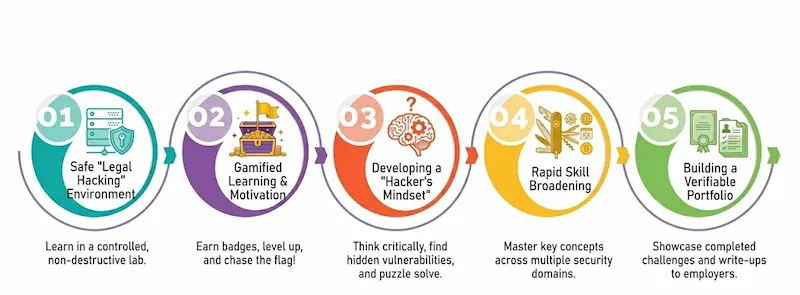
With terminology like "Flag" (the target string), "Write-up" (the solution guide), and "Pwn" (effectively exploiting a target), a CTF Terminology Cheat Sheet offers the basic language for navigating tournaments.
Technical responsibilities and activities like "Box" (a target virtual machine), "OSINT" (open-source intelligence collection), and "Payload" (the code needed to execute an exploit) are also defined.
|
S.No. |
Challenges |
What? |
|
1. |
Web Exploitation |
To obtain illegal access, you identify and get around flaws in online applications such as SQL Injection, Cross-Site Scripting (XSS), or vulnerable API endpoints. |
|
2. |
Cryptography |
You can find weak hashing methods, study and "break" encryption schemes, or take advantage of incorrect implementations of contemporary protocols like Elliptic Curve or RSA. |
|
3. |
Binary Exploitation (Pwn) & Reverse Engineering |
To comprehend the logic of compiled programs (EXE/ELF), you disassemble them. Then, you create payloads that take over the program's memory and run your own code. |
|
4. |
Digital Forensics & OSINT |
You can employ Open-Source Intelligence (OSINT) to uncover flags concealed in public internet data, or you can look at "digital crime scenes" by examining disk images, network packets, and metadata. |
|
5. |
AI & Cloud Security (New for 2026) |
You test "Prompt Injection" approaches to control LLM-driven security bots, protect against Agentic AI breaches, and take advantage of incorrectly configured S3 buckets. |
You can expect the following things in your first CTF:
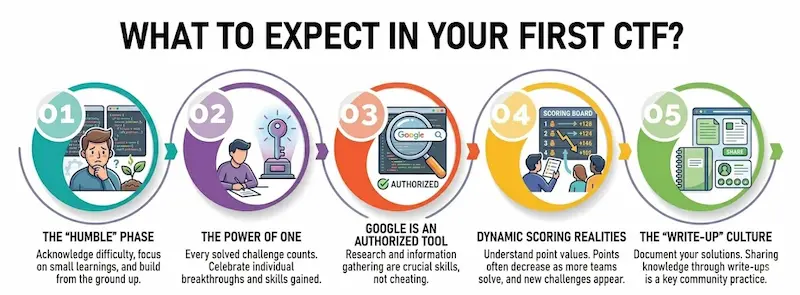
● The "Humble" Phase: You should anticipate feeling stuck at first since CTF challenges are not textbook problems; rather, they are puzzles meant to force you to think "sideways" and actively search for fresh ideas.
● The Power of One: Don't attempt to solve every problem. Capturing just one flag, which demonstrates your ability to bridge the gap between a problem and a solution, is sometimes used to determine success in your first event.
● Google is an Authorized Tool: In 2026, even professionals employ AI assistants to help break complex code patterns in real-time, so it's not cheating to look up how a certain cipher works or how to use a new tool.
● Dynamic Scoring Realities: Many contemporary CTFs include "dynamic scoring," which means that a challenge's point value drops as more players complete it, beginning with the simpler jobs to gain momentum before the points plummet.
● The "Write-up" Culture: Reading other participants' Write-ups (step-by-step answers) after the event is the most beneficial approach to see the dozens of alternative ways the same problem could have been solved.
Large Language Models (LLMs) will be used in AI-Assisted Exploitation and Defense in 2026 to automate vulnerability detection and quick patch development, transforming laborious manual audits into real-time conflicts.
While defenders utilize Sovereign AI to anticipate breach patterns and independently separate affected network regions, attackers use these agents to "fuzz" code and create polymorphic malware.
|
S.No. |
Skills |
What? |
|
1. |
Advanced Research & "Google-Fu" |
To solve issues you've never encountered before, you quickly learn how to locate cryptic documentation, exploit database entries (CVEs), and technical whitepapers. |
|
2. |
Scripting & Automation (Python/ Bash) |
Writing bespoke scripts to automate tedious operations, like "brute-forcing" a login or searching through thousands of lines of log data for a hidden flag, will help you stay competitive. |
|
3. |
Analytical Troubleshooting |
By dissecting a system to determine its "breaking point," CTFs teach you how to methodically test theories until you pinpoint the precise vulnerability. |
|
4. |
Tool Agility |
You become proficient with a variety of professional tools, including Burp Suite for web interception and Ghidra for reverse engineering, and learn when and how to use them. |
|
5. |
Technical Documentation (Write-ups) |
The ability to communicate complicated technical vulnerabilities to others is a crucial talent for experienced penetration testers and auditors, and it may be developed by recording your approach to the flag. |
The following are some of the tools and platforms used in CTF:
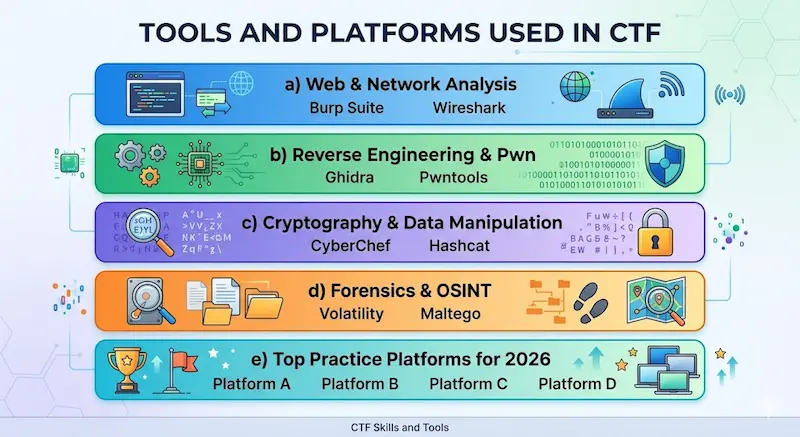
a) Web & Network Analysis (Burp Suite & Wireshark): Use Wireshark to analyze raw network packets for hidden data and Burp Suite (now with AI-augmented scanning) to intercept and modify HTTP traffic.
b) Reverse Engineering & Pwn (Ghidra & Pwntools): Use the Pwntools Python module to automate the development of sophisticated exploits after decompiling binaries using the NSA's Ghidra to comprehend logic.
c) Cryptography & Data Manipulation (CyberChef & Hashcat): Use Hashcat to use GPU power to crack password hashes and CyberChef (the "Cyber Swiss Army Knife") for quick decoding and encoding.
d) Forensics & OSINT (Volatility & Maltego): Use Volatility to analyze compromised RAM dumps, then use Maltego or the AI-powered Cyble ODIN for open-source intelligence to map out threat actor footprints.
e) Top Practice Platforms for 2026: For fundamentals, start with picoCTF; for guided labs, use TryHackMe; and for elite competition, take on Hack The Box or Cyber Security Challenge India.
The following are the best CTF platforms to practice in 2026:
|
S.No. |
Factors |
How? |
|
1. |
Start with India-Specific Labs |
To practice beginner-friendly, real-world scenarios suited to the Indian cybersecurity environment and VAPT (Vulnerability Assessment and Penetration Testing) requirements, sign up for Crack The Lab (Craw Security). |
|
2. |
Master the Fundamentals on TryHackMe |
Through guided, step-by-step rooms, finish the "Pre-Security" and "Jr. Penetration Tester" study courses to develop a strong foundation in networking, Linux, and web vulnerabilities. |
|
3. |
Build Your Technical Toolkit |
Install a Kali Linux virtual machine (VM) and become familiar with "The Big Four" tools: CyberChef (data decoding), Burp Suite (web interception), Ghidra (reverse engineering), and Nmap (network scanning). |
|
4. |
Practice "Free-Play" on picoCTF |
Enter the picoGym and work on unsupervised, unguided challenges ranging from straightforward "General Skills" to intricate "Binary Exploitation," which will help you cultivate a self-sufficient hacker attitude. |
|
5. |
Read and Write "Write-ups" |
Read other players' solutions (write-ups) after each task or competition to discover different approaches, and record your own procedure to create a professional portfolio for potential jobs. |
The following are the importance of CTF Write-ups:
● Reinforces Learning through Teaching: You are forced to fully comprehend the underlying weakness when a sophisticated exploit is explained in simple terms, transferring the knowledge from short-term memory to long-term mastery.
● Builds a Professional Portfolio: A collection of excellent articles on GitHub or a personal blog can be used by novices in India and overseas as a "Technical Resume," demonstrating to potential employers that you have communication and analytical abilities.
● Identifies Knowledge Gaps: Writing down a solution compels you to investigate the why behind the how, which frequently shows "foggy" regions where you would have guessed a command.
● Contributes to the Community: In the Indian and international CTF communities (such as the InCTF circles), sharing your own viewpoint or a bespoke script benefits other students and builds your reputation.
● Refines "Reporting" Skills: CTF write-ups are the ideal "low-stakes" exercise for creating concise, useful executive and technical summaries; professional penetration testers devote half of their time to preparing reports for clients.
The following are some of the career benefits of learning CTF in cybersecurity:
a) Proof of Practical Competence: A persistent CTF track record on sites like Hack The Box or Crack The Lab offers 100% verifiable proof that you can actually exploit and defend systems, not merely pass an exam, in contrast to theoretical certificates.
b) Accelerated Path to High-Value Roles: Frequent CTF players frequently skip entry-level "triage" positions in favor of highly sought-after specialties like Red Teaming, Exploit Development, and Incident Response.
c) Mastery of the "Technical Interview": A "Live-Fire" challenge is currently part of the majority of contemporary cybersecurity interviews in India (at companies like TCS, Infosys, or specialist startups). The pressure is relieved by CTF experience, which makes these technological obstacles seem like any other game.
d) Networking with Elite Global Talent: Recruiters spend a lot of time scouting elite tournaments like DEF CON or India's InCTF. Ranking highly on a leaderboard can result in direct employment offers and "fast-track" recommendations from seasoned professionals.
e) Preparedness for AI-Native Threats: You may show employers that you are prepared to safeguard the next generation of AI-driven business infrastructure by taking on 2026-specific issues like Prompt Injection and Automated Kill Chains.
1. Is CTF time free?
Yes, CTFtime is an entirely free, nonprofit community platform that never charges participants or organizers for listing events, monitoring ratings, or gaining access to its worldwide write-up library.
2. Does CTF require coding?
While many novice challenges may be solved with already-available tools, basic coding (often Python or Bash) is necessary for intermediate and advanced CTF success in order to automate repetitive activities, take advantage of memory issues, and decode complex data.
3. What are the 4 types of security?
The following are the 4 types of security:
a) Physical Security,
b) Network Security,
c) Application Security, and
d) Information (Data) Security.
4. What skills do I need for CTF?
You need the following skills for CTF:
a) Linux & Command Line Mastery,
b) Networking Foundations,
c) Scripting & Automation (Python/Bash),
d) Web & Binary Analysis, and
e) Resourceful Problem Solving (Google-Fu).
5. Is Google CTF hard?
Although the primary Google CTF is regarded as "hardcore" and targeted at experienced experts, Google also offers a special "Beginner's Quest" with a narrative-driven set of tasks intended to be understandable and instructive for novices.
6. What are the top 3 skills for cybersecurity experts?
The following are the top 3 skills for cybersecurity experts:
a) AI-Augmented Threat Detection & Response,
b) Cloud & Infrastructure Architecture Security, and
c) Strategic Risk Communication (The "Bridge" Skill).
7. Can AI do CTF?
Yes, by 2026, AI agents will be able to handle more than 90% of beginner to intermediate CTF tasks on their own. They have also started to outperform 99% of human competitors in top worldwide rankings.
8. What language does CTF use?
Although there isn't a single language used by CTFs, Python serves as the universal "glue" for automation, C/C++ and Assembly are necessary for binary exploitation, and SQL, PHP, and JavaScript are the fundamental languages of web-based challenges.
9. Who do hackers target the most?
Hackers mostly target the following individuals:
a) Critical Infrastructure & Healthcare,
b) The "Supply Chain" (Third-Party Vendors),
c) Financial Services & Fintech,
d) Small and Medium Enterprises (SMEs), and
e) Remote Workers & "Identity".
Now that we have talked about CTF in Cybersecurity, you might want to learn more about where you can get this amazing training from. For that, you can get in contact with Craw Security, offering the Crack The Lab a dedicated CTF platform that gives the experience of real-time fire malware.
Students will be able to test their skills on this platform as much as they want and gain adequate experience to compete in big, real bounty events. What are you waiting for? Contact, Now!
Cybersecurity Insights