Red Teaming
Top Red Team Tools Every Ethical Hacker Should Know
Pawan PanwarApr 19, 2026
Preparing your workspace...
Loading latest data
Loading article...
Preparing blog content

Do you want to know about the Top Red Team Tools Every Ethical Hacker Should Know? If yes, then you are at the right place. Here, we will talk about these amazing Red Team tools in detail so that you can learn how they are used.
Moreover, we will introduce you to a reputable Catch The Flag training platform offered by a reputable VAPT service provider. What are we waiting for? Let’s get straight to the topic!
In order to assess an organization's defensive capabilities, a Red Team tool is a specific software or framework that mimics the tactics, methods, and procedures (TTPs) of actual attackers.
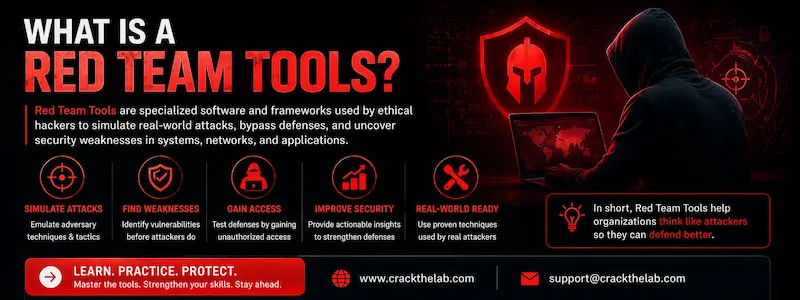
These tools, in contrast to conventional security scanners, concentrate on lateral movement, persistent access, and stealth to find weaknesses in people, procedures, and technology. They assist ethical hackers in providing a realistic evaluation of how well a security team can identify and address a complex breach by imitating real intrusions.
Let’s take a look at the Top Red Team Tools Every Ethical Hacker Should Know and see how they work!
|
S.No. |
Topics |
Factors |
What? |
|
1. |
Red Teaming |
Goal |
Focuses on mimicking a particular, real-world opponent in order to evaluate the organization's detection and response capabilities. |
|
Methodology |
Use covert, multi-layered strategies, such as physical security breaches and social engineering, to get beyond defenses without being discovered. |
||
|
Outcome |
Gives a realistic evaluation of the "Blue Team"'s (defenders') ability to recognize, stop, and neutralize a complex attack. |
||
|
2. |
Penetration Testing |
Goal |
Focuses on finding as many vulnerabilities as possible within a particular scope (such as a network or online application) in order to stop exploitation. |
|
Methodology |
Frequently employs a loud, methodical technique to identify "holes" in the system, typically with the internal IT team's full knowledge. |
||
|
Outcome |
Produces a thorough list of vulnerabilities together with a patching and repair roadmap. |
The following are the top Red Team Tools that every ethical hacker should know:
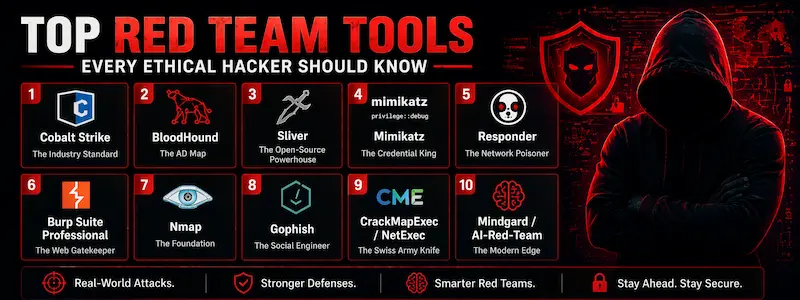
1. Cobalt Strike (The Industry Standard)
● Role: Post-exploitation and Command & Control (C2).
● Why it matters: It is the "gold standard" for simulating adversaries. Red teamers can use "beacons" (agents) to coordinate sophisticated attacks across a team, avoid EDR (Endpoint Detection and Response), and sustain persistent access.
2. BloodHound (The AD Map)
● Role: Active Directory (AD) Analysis & Privilege Escalation.
● Why it matters: Graph theory is used by BloodHound to uncover hidden linkages in an AD environment. It is maybe the most effective tool for internal network movement since it displays the precise route from a low-level user account to Domain Admin.
3. Sliver (The Open-Source Powerhouse)
● Role: Command & Control (C2).
● Why it matters: Sliver became the most popular open-source substitute as defenses became more adept at identifying Cobalt Strike. With sophisticated features like automated obfuscation and several transport protocols (DNS, HTTP/TLS) to avoid detection, it is cross-platform (Go-based).
4. Mimikatz (The Credential King)
● Role: Credential Access.
● Why it matters: Mimikatz is still crucial for retrieving hashes, PINs, and plaintext passwords from memory despite its age. For "Pass-the-Hash" and "Pass-the-Ticket" assaults, it is the preferred tool.
5. Responder (The Network Poisoner)
● Role: Initial Access & Lateral Movement.
● Why it matters: The poisoning of LLMNR, NBT-NS, and MDNS requests is automated by Responder. Within minutes after joining the network, you can obtain a collection of user hashes in many corporate settings by just executing Responder.
6. Burp Suite Professional (The Web Gatekeeper)
● Role: Web Application & API Exploitation.
● Why it matters: Burp cannot be compromised because the majority of contemporary "perimeters" are actually web applications and APIs. It is used by red teamers to detect IDOR flaws, evade authentication, and insert malicious payloads into web traffic.
7. Nmap (The Foundation)
● Role: Reconnaissance & Enumeration.
● Why it matters: Without Nmap, no engagement can begin. It finds open ports, maps the attack surface, and finds service versions. Its "NSE" (Nmap Scripting Engine) remains the quickest method for identifying low-hanging fruit, such as unpatched vulnerabilities, in 2026.
8. Gophish (The Social Engineer)
● Role: Initial Access (Phishing).
● Why it matters: The majority of red team breaches start with a person. Gophish is a professional-grade framework for securely obtaining credentials, tracking who clicked, and overseeing extensive phishing simulations.
9. CrackMapExec / NetExec (The Swiss Army Knife)
● Role: Lateral Movement & Enumeration.
● Why it matters: You may automate the "spraying" of credentials throughout an entire network with these technologies. With a single line of code, you may run commands, leak secrets, and determine whether a password that has been obtained works on 1,000 distinct devices at once.
10. Mindgard / AI-Red-Team (The Modern Edge)
● Role: AI & LLM Security Testing.
● Why it matters: Tools like Mindgard, which are new for 2026, are crucial as businesses are now using AI agents. Prompt Injection and data leaking, the new frontier of the attack surface, are tested for by these technologies.
The following are the benefits of Red Team Tools for Every Ethical Hacker:
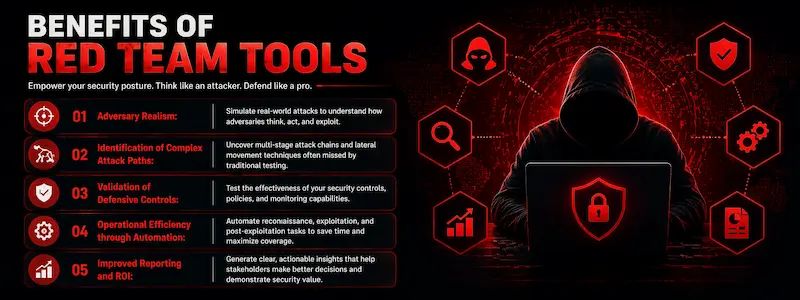
● Adversary Realism: In order to deliver a realistic security evaluation, they allow hackers to imitate the same stealth and persistence employed by sophisticated threat actors.
● Identification of Complex Attack Paths: These tools show how a "Crown Jewel" asset can be compromised by a series of small, seemingly unrelated flaws.
● Validation of Defensive Controls: They offer concrete evidence of whether current security investments, such as EDRs and SIEMs, indeed cause alarms during an actual intrusion attempt.
● Operational Efficiency through Automation: Red teamers can concentrate on high-level strategy and innovative exploitation by automating monotonous operations like network scanning and credential spraying.
● Improved Reporting and ROI: They produce data-driven insights that enable hackers to show stakeholders the concrete business risk of a breach, greatly increasing the persuasiveness of security recommendations.
|
S.No. |
Topics |
Factors |
What? |
|
1. |
Commercial Toolkits |
Professional Support and Stability |
These products (such as Cobalt Strike or Burp Suite Pro) guarantee dependability during crucial operations because they have devoted support teams, frequent upgrades, and copious documentation. |
|
Advanced Evasion Features |
They frequently come with integrated, "battle-tested" obfuscation and bypass methods made especially to get beyond contemporary EDR and AV systems without the need for manual adjustment. |
||
|
Comprehensive Reporting |
In order to save hours of human documentation, commercial suites usually include automated reporting engines that convert technical results into executive-friendly metrics. |
||
|
2. |
Open-Source Toolkits |
Customization and Flexibility |
Because the source code is available, hackers can alter programs (such as Sliver or Metasploit) to produce unique communication protocols or custom payloads that some defenses could miss. |
|
Community-Driven Innovation |
For open-source products, the community frequently releases new exploits and modules before commercial companies can include them in official upgrades. |
||
|
Cost-Effectiveness for Learning |
Without the expensive license costs connected with enterprise-grade software, these technologies give ethical hackers a free way to establish labs and hone their abilities. |
Following industries demand Red Team Tools:
a) Banking and Financial Services (BFSI): Prevents significant financial fraud and safeguards valuable transaction data.
b) Government and Defense: Protects citizen data and secret national security intelligence.
c) Healthcare and Pharmaceuticals: Protects confidential patient data and unique medication research.
d) Energy and Critical Infrastructure: Protects water and electricity systems, preventing catastrophic physical damage.
e) E-commerce and Retail: Keeps shops in high availability while protecting customer payment information.
f) Technology and SaaS Providers: Keep supply chain assaults at bay and guarantee the integrity of cloud platforms.
g) Telecommunications: Prohibits widespread data interception and safeguards international communication networks.
The following individuals can use Red Team Tools:
|
S.No. |
Factors |
How? |
|
1. |
Hypervisor Setup |
To host and administer several separate virtual machines, start by installing a virtualization software such as VMware Workstation, Proxmox, or VirtualBox. |
|
2. |
Target Environment (Active Directory) |
Build a domain controller using Windows Server Evaluation ISOs, then connect many Windows workstations to perform lateral movement and BloodHound. |
|
3. |
Attack Platform |
As your main "attacker" machine, set up a dedicated Kali Linux or Parrot OS instance that is already equipped with the previously mentioned tools. |
|
4. |
Vulnerable-by-Design Apps |
To practice online exploitation and service-based attacks, integrate intentionally vulnerable systems such as Metasploitable or OWASP Juice Shop. |
|
5. |
Network Isolation & Logging |
Set up an ELK stack to examine how your attacks appear to a defender and use a virtual firewall (such as pfSense) to keep your lab traffic apart from your home Wi-Fi. |
Now that we have talked about the Top Red Team Tools Every Ethical Hacker Should Know, you might want to learn how to use such tools and where to use them. For that, you can get in contact with Craw Security, offering a dedicated Catch The Flag platform, “Crack The Lab” to cybersecurity practitioners.
Moreover, you will be able to test your knowledge & skills on this platform while fighting against fire malware. You will be able to improve your skills. What are you waiting for? Contact, Now!
Most Viewed Articles