Cyber Security
Top Pentesting Methodologies Every Beginner Should Know
Pawan PanwarMay 11, 2026
Preparing your workspace...
Loading latest data
Loading article...
Preparing blog content

Do you want to learn about Pentesting Methodologies and in what sense they can be used? If yes, then you are at the right place. Here, we will talk about Pentesting Methodologies in detail and their benefits.
Moreover, we will introduce you to a reliable Catch The Flag platform offered by a reputable VAPT service provider. What are we waiting for? Let’s get straight to the topic!
Security professionals actively search for weaknesses in an organization's systems, networks, and applications during penetration testing, often known as "ethical hacking," a controlled cyberattack simulation.

Finding and taking advantage of flaws like unpatched software or incorrect configurations before malevolent actors may discover them is the aim. IT teams may increase their overall defense posture against real-world threats by using this process, which offers a comprehensive path for patching security flaws.
Let’s talk about what Pentesting Methodologies are, their benefits, and how you can use them in a professional way!
For the following reasons, penetration testing matters:

|
S.No. |
Topics |
Factors |
What? |
|
1. |
Black Box Testing |
Real-World Simulation |
The tester mimics the viewpoint of an external hacker who must find flaws from the beginning since they have no prior knowledge of the internal systems. |
|
Focus on the External Perimeter |
It is perfect for evaluating assets that are visible to the public, such as firewalls and web servers, to determine how simple it is for an intruder to gain access. |
||
|
2. |
White Box Testing |
Comprehensive Internal Audit |
Testers get full access to IP addresses, network diagrams, and source code, enabling a thorough search for deeply ingrained flaws. |
|
Time Efficiency |
Testers can quickly concentrate on intricate logic errors and high-risk regions within the system architecture since no time is lost on reconnaissance. |
||
|
3. |
Grey Box Testing |
Balanced Approach |
In order to simulate a "malicious insider" or a privileged attacker, the tester is provided with limited information, such as low-level user credentials or a simple network diagram. |
|
Targeted Efficiency |
It enables testers to spend more time assessing the security of internal data permissions and lateral movement issues by avoiding the initial exploration. |
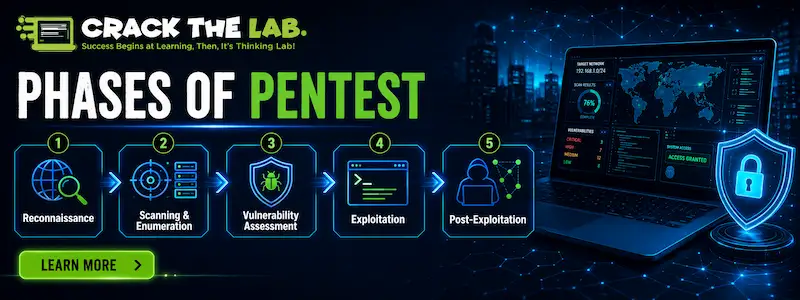
The following are some key phases of a standard pentest process:
● Reconnaissance: Collecting information and intelligence that is accessible to the public to map the target's digital footprint and possible entry points.
● Scanning & Enumeration: To find open ports, active hosts, and particular services operating on the target network, use active tools.
● Vulnerability Assessment: Identifying and ranking certain security flaws and unpatched software by analyzing the collected data.
● Exploitation: Attempting to use the vulnerabilities found to safely get around security measures and access the system.
● Post-Exploitation: Estimating the hacked machine's worth, trying to elevate privileges, and figuring out lateral movement routes.
The following are the basics of pentesting methodologies:
a) OSSTMM: Uses thorough, metrics-driven scientific testing to concentrate on measurable operational security.
b) OWASP: The best method for locating and fixing web application flaws like XSS and SQL injection.
c) NIST SP 800-115: A thorough technical manual that government agencies can use to perform reliable security evaluations and testing.
d) PTES: Establishes a superior baseline for every stage of the pentest lifecycle, from pre-engagement to thorough reporting.
e) ISSaf: A highly technical architecture that connects different testing stages and regulatory requirements with certain security technologies.
|
S.No. |
Tools |
Why? |
|
1. |
Nmap (Network Mapper) |
The industry-standard method of transmitting packets and examining the responses to find hosts and services on a computer network. |
|
2. |
Burp Suite Professional |
An integrated framework for online application security testing with an emphasis on web traffic manipulation and interception. |
|
3. |
Metasploit Framework |
An effective tool for creating and running exploit code against a distant target computer. |
|
4. |
Nessus Professional |
A popular proprietary vulnerability scanner that finds security holes and configuration mistakes automatically. |
|
5. |
Hashcat/ John the Ripper |
System passwords and encryption hashes are tested using sophisticated password recovery and cracking tools. |
The last and most important stage of a pentest is reporting and remediation, when the results are recorded into a clear, useful roadmap for stakeholders. Vulnerabilities are ranked according to risk level in the final report, which also includes executive summaries for management and technical information for developers to fix.
Fixing the found defects is only one aspect of successful remediation; another is retesting the environment to make sure the patches were applied appropriately and haven't caused any new stability problems.
In the following ways, you can choose the right methodology as a beginner:
Now that we have talked about what Pentesting Methodologies are, you might want to use your skills and test whether you can protect yourself against cyberattacks or not. For that, you can go for Crack The Lab, a dedicated Catch The Flag platform offered by Craw Security.
On this platform, cybersecurity professionals, even beginners, will be able to use their knowledge & skills to protect a demo website against rival teams’ cyberattacks. This will boost the morale of ethical hacking aspirants. What are you waiting for? Contact, Now!
Penetration testing is a cyberattack simulation carried out by qualified professionals to find and take advantage of system weaknesses before malevolent hackers can.
The following are some of the different types of pentesting methodologies:
a) OWASP WSTG (Web Security Testing Guide),
b) PTES (Penetration Testing Execution Standard),
c) OSSTMM (Open Source Security Testing Methodology Manual),
d) NIST SP 800-115, and
e) ISSAF (Information Systems Security Assessment Framework).
The following are the 7 steps of pentesting:
a) Pre-engagement Interactions,
b) Intelligence Gathering (Reconnaissance),
c) Threat Modeling,
d) Vulnerability Analysis,
e) Exploitation,
f) Post-Exploitation, and
g) Reporting.
The following are the 7 types of cybersecurity:
a) Network Security,
b) Application Security,
c) Cloud Security,
d) Information (Data) Security,
e) Endpoint Security,
f) Mobile Security, and
g) Critical Infrastructure Security.
The OWASP methodology is a comprehensive framework that integrates security testing throughout the whole software development lifecycle (SDLC) in order to identify and mitigate web application vulnerabilities.
The following are the 4 types of vulnerabilities:
a) Software Vulnerabilities,
b) Network Vulnerabilities,
c) Configuration Vulnerabilities, and
d) Human Vulnerabilities.
The following are the 5 types of cybersecurity:
a) Network Security,
b) Application Security,
c) Cloud Security,
d) Endpoint Security, and
e) Critical Infrastructure Security.
Because SonarQube examines source code for flaws and quality problems without actually running the program, it is an SAST (Static Application Security Testing) tool.
L2 analysts conduct in-depth investigations and incident response, L3 analysts concentrate on advanced threat hunting and forensic analysis, while L1 analysts manage initial alert triage and monitoring.