Threat Intelligence
Top 10 SIEM (Security Information and Event Management) Tools For 2026
Pawan PanwarApr 25, 2026
Preparing your workspace...
Loading latest data
Loading article...
Preparing blog content
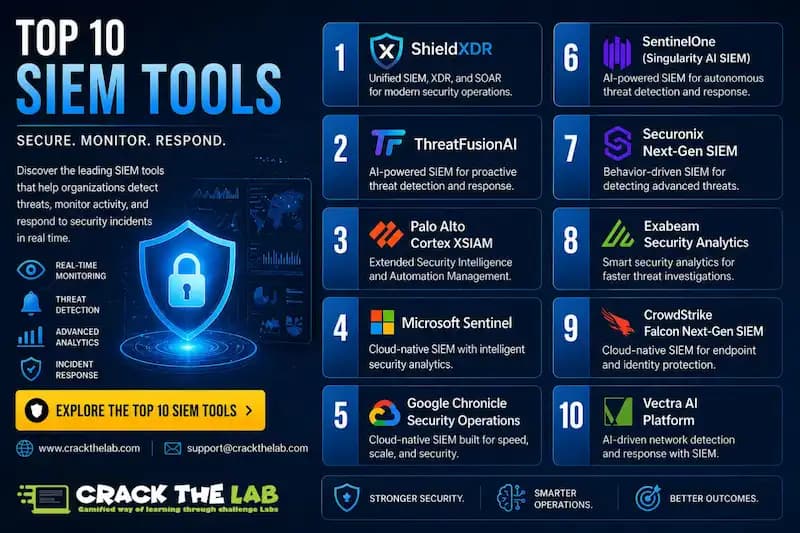
Do you want to talk about the Top 10 SIEM Tools? If yes, then you are at the right place. Here, we’ll begin by explaining what SIEM is, and later, we’ll explore the benefits SIEM can bring you. Moreover, we will introduce you to the best resources that can help you with clearing your thoughts about cybersecurity tools and management. What are we waiting for? Let’s get started!
In order to give real-time insight into security occurrences, a Security Information and Event Management (SIEM) system is a centralized platform that gathers and examines log data from throughout an organization's IT infrastructure.
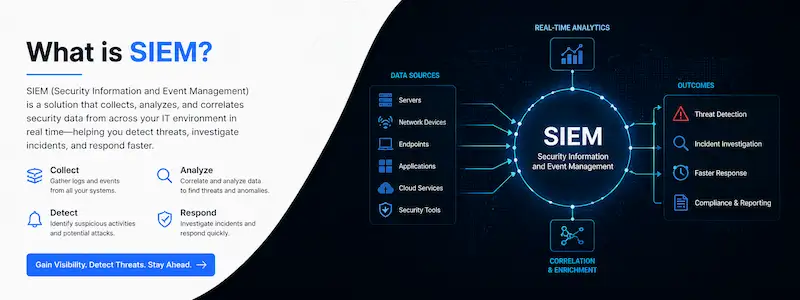
Security teams can effectively identify and address threats by identifying abnormal patterns or deviations from established baselines that may indicate a cyberattack through the correlation of diverse data sets.
Additionally, SIEM systems frequently provide automated alerting and compliance reporting capabilities, which are essential components of contemporary Security Operations Centers (SOCs). Let’s talk about the Top 10 SIEM Tools and how they are used!
|
S.No. |
Factors |
What? |
|
1. |
Log Aggregation & Normalization |
Gathers, cleans, and unifies enormous amounts of data from various sources into a single, searchable format. |
|
2. |
Real-Time Threat Detection |
Uses behavioral analytics and correlation methods to quickly spot and notify users of known attack signatures or suspicious tendencies. |
|
3. |
Incident Investigation & Forensics |
Reconstructs attack timelines and examines the underlying causes of security incidents using its robust search and visualization features. |
|
4. |
Compliance Reporting |
Simplifies compliance with legal standards such as GDPR, HIPAA, or PCI-DSS by automating the gathering and preparation of audit data. |
|
5. |
Security Orchestration Integration |
Connects to SOAR and other security technologies to automatically initiate remediation actions or workflows in response to threats found. |
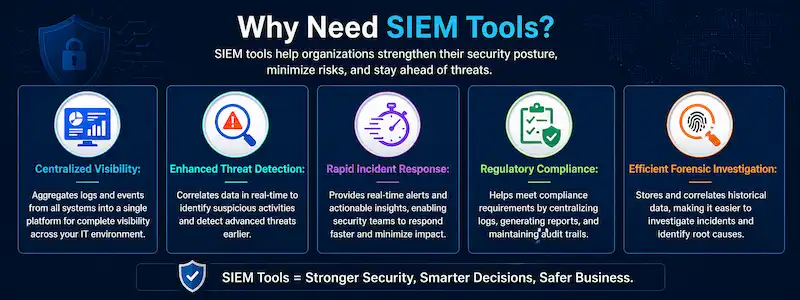
You need SIEM tools for the following reasons:
The following are the top 10 SIEM tools in 2026:
● SentinelOne: Provides AI-powered, autonomous threat detection and response throughout the entire company infrastructure by utilizing a cloud-native Singularity Data Lake.
● Splunk: A highly scalable platform for complex business contexts that provides broad correlation rules, sophisticated security analytics, and a strong ecosystem of integrations.
● Datadog: Enables teams to instantly correlate application performance data with security incidents by integrating security monitoring directly into its observability platform.
● IBM QRadar SIEM: Reduces noise and speeds up investigations by combining deep integration with SOAR capabilities, automatic alarm prioritization, and enterprise-grade AI.
● LogRhythm: Focuses on behavioral analytics and high-performance log management to assist enterprises in identifying sophisticated attacks and insider threats through centralized visibility.
● Graylog: Offers a versatile, open-core log management system with strong visualization and ad hoc search capabilities for effective historical threat analysis.
● Trellix Helix: Provides a unified security operations platform that streamlines SOC operations by combining detection, investigation, and response activities into a single interface.
● Sprinto: Primarily a compliance automation platform with SIEM-like monitoring features to assist businesses in keeping an eye on security measures and fulfilling legal obligations.
● LogPoint: Enhances comprehensive threat intelligence by providing a flexible SIEM solution with strong User and Entity Behavior Analytics (UEBA) and smooth third-party interaction.
● Fortinet FortiSIEM: Gives businesses with current Fortinet infrastructure a centralized perspective by automating log collection and event correlation across multi-cloud and virtual systems.
|
S.No. |
Factors |
How? |
|
1. |
Scalability and Infrastructure Compatibility |
Assess the tool's native support for your particular on-premises, cloud, or hybrid setups and its capacity to handle different data quantities without experiencing performance deterioration. |
|
2. |
Detection and Analytics Maturity |
Examine the platform's capacity to include actionable threat intelligence, its use of machine learning to lower false positives, and its library of established correlation rules. |
|
3. |
Automation and Incident Response |
Seek a smooth interaction with SOAR features that will enable the system to rapidly alert teams or isolate hazards by automatically triggering established playbooks. |
|
4. |
Total Cost of Ownership (TCO) |
In addition to the licensing fees, take into account the hidden expenses associated with the volume of log ingestion, the hardware or cloud computing resources that are required, and the staff time needed for maintenance and tuning. |
|
5. |
Forensic and Compliance Capabilities |
Make sure the tool offers automatic, audit-ready reporting templates and long-term, searchable log archives for the particular regulatory frameworks (such as GDPR, HIPAA, and PCI-DSS) pertinent to your sector. |
1. What are the three types of SIEM?
The following are the 3 types of SIEM:
a) Cloud-Native SIEM,
b) On-Premises SIEM, and
c) Hybrid SIEM.
2. What steps are involved in deploying a SIEM tool?
The following steps are involved in deploying a SIEM tool:
a) Requirements Gathering & Scope Definition,
b) Architecture & Infrastructure Planning,
c) Log Source Integration & Data Normalization,
d) Configuration of Detection Rules & Dashboards, and
e) Testing, Tuning & Workflow Integration.
3. How do SIEM Tools Work?
In the following ways, SIEM tools work:
a) Data Collection & Aggregation,
b) Normalization & Parsing,
c) Correlation & Analytics,
d) Alerting & Prioritization, and
e) Storage, Reporting & Retention.
4. Key Benefits of SIEM Tools
The following are the key benefits of SIEM tools:
a) Unified Visibility,
b) Proactive Threat Detection,
c) Accelerated Incident Response,
d) Simplified Compliance & Auditing, and
e) Enhanced Forensic Capability.
5. What are the roles of SIEM tools?
The following are the roles of SIEM tools:
a) Centralized Data Aggregation,
b) Threat Detection and Correlation,
c) Incident Response Acceleration,
d) Regulatory Compliance Management, and
e) Forensic Investigation Support.
6. How do SIEM tools collect data?
Lightweight agents deployed on endpoints, direct API connections with cloud services, and network-level log forwarding protocols like Syslog or SNMP to ingest, parse, and normalize logs from various infrastructure sources are all ways that SIEM technologies gather data.
7. Which is the best SIEM tool in the market so far?
One of the best SIEM tools available in the market so far is ShieldXDR, offered by Craw Security
Conclusion
Now that we have talked about the Top 10 SIEM Tools, you might want to know where you can get the best SIEM tool. For that, you can get in contact with Craw Security, offering ShieldXDR, which offers great security features for your systems and website.
Moreover, if you want to test your cybersecurity knowledge & skills on a dedicated platform, you can go for the amazing Crack The Lab, a dedicated Catch The Flag platform offered by Craw Security as well. What are you waiting for? Contact, Now!