Blue team
Red Team vs Blue Team: Why Training Both Sides Makes You a Better Hacker?
Daksh KatariaJun 19, 2026
Preparing your workspace...
Loading latest data
Loading article...
Preparing blog content
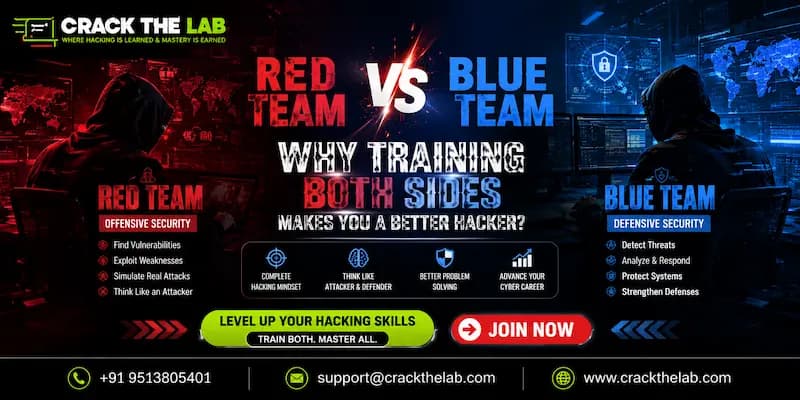
Do you know what Red Team and Blue Team Cybersecurity Roles are and how you can learn both skills? If not, then you are at the right place. Here, we will talk about how both teams work and what tools & techniques they use in detail.
Moreover, we will introduce you to a reliable Capture The Flag platform offered by a reputable VAPT service provider. What are we waiting for? Let’s get started!
The two main pillars of operational cybersecurity are represented by Red Teams and Blue Teams. Red Teams are ethical adversaries that mimic actual cyberattacks to find hidden system vulnerabilities, while Blue Teams serve as the ongoing internal defense force responsible for network monitoring, anomaly detection, and active threat mitigation.
By directly evaluating defensive preparedness against actual attack vectors, their coordinated operational exercises give organizations an unbiased evaluation of their security posture.
A Red Team is a team of security experts and ethical hackers hired to mimic actual cyberattacks against an organization's staff, infrastructure, and physical security. Their main objective is to surreptitiously go around current protections in order to find operational flaws, misconfigurations, and hidden vulnerabilities before real threat actors can take advantage of them.
An internal security team known as a "Blue Team" is in charge of constantly keeping an eye on, protecting, and bolstering an organization's digital assets and network architecture from potential cyberattacks.
Maintaining an active line of defense, quickly analyzing security alarms, and eliminating active network breaches before they may cause data loss or system outages are their core goals.
|
S.No. |
Topics |
Factors |
What? |
|
1. |
Red Team |
Core Objective |
To evaluate the organization's overall detection and response capabilities, imitate cunning real-world adversaries, and aggressively exploit vulnerabilities. |
|
Tactics and Methods |
Employs offensive techniques such as credential harvesting, social engineering (phishing/vishing), black-box penetration testing, and physical security circumvention. |
||
|
Operational Mindset |
Takes a proactive, extremely inventive, and hostile stance, concentrating on identifying a single vulnerable port of entry to breach a network. |
||
|
2. |
Blue Team |
Core Objective |
Maintaining operational uptime, detecting, analyzing, and neutralizing incoming security incidents in real time, and consistently protecting organizational digital assets. |
|
Tactics and Methods |
Employs defensive techniques such as proactive patch management, log analysis through SIEM systems, Endpoint Detection and Response (EDR) tuning, and ongoing network monitoring. |
||
|
Operational Mindset |
Adopts a thorough, reactive-to-proactive defensive stance, bearing the responsibility of simultaneously securing every potential entry point. |
The following are some common tools used by both teams:
1. Reconnaissance and Discovery (Offensive): While Shodan and Amass find internet-facing assets and exposed subdomains, Nmap maps network topology and open ports.
2. Exploitation Frameworks and C2 (Offensive): Cobalt Strike and Sliver create permanent Command and Control (C2) channels within hacked networks, while Metasploit automates vulnerability exploitation.
3. Security Information and Event Management / SIEM (Defensive): Cross-platform log data is combined by Microsoft Sentinel and Splunk Enterprise Security to identify irregularities and initiate automatic incident response playbooks.
4. Endpoint Detection and Response / EDR (Defensive): In order to automatically prevent and treat active host infections, CrowdStrike Falcon and SentinelOne Singularity track system-level activities in real time.
5. Shared Traffic and Packet Analyzers (Dual-Use): While Burp Suite intercepts and modifies live HTTP/S traffic to audit application-layer requests, Wireshark records raw network packets for detailed protocol analysis.
Cybersecurity professionals need both skills for the following reasons:
● Accelerates Incident Remediation: Defenders can anticipate a hacker's next step and contain breaches more quickly when they are aware of attack paths.
● Eliminates Security Blind Spots: Teams can identify hidden misconfigurations that conventional defenses overlook by adopting an adversarial mindset.
● Optimizes Tool and Alert Tuning: Comprehending actual exploit mechanisms minimizes false positives and concentrates alerts on genuine risks.
● Enhances Secure Code and Architecture Design: Developers can create networks that are intrinsically robust by anticipating how systems would malfunction.
● Fosters Effective Purple Teaming: Combining the two abilities dismantles team silos and transforms hostile testing into cooperative defense improvements.
Purple Teaming is a cooperative security approach in which defensive (Blue) and offensive (Red) teams collaborate in real-time exercises to freely exchange technical information and ideas.
This dynamic feedback loop guarantees that simulated attack methods are instantly assessed to quickly develop, test, and improve a network's defensive detection rules rather than functioning in silos.
The Purple Team mentality transforms cybersecurity from an antagonistic "us versus them" contest into a cohesive, ongoing feedback loop where defensive power is directly increased by offensive knowledge.
Instead of waiting for a breach to happen, experts employ attacker strategies to actively develop, evaluate, and refine real-time detection rules by dismantling operational silos.
The following are some real-world collaboration scenarios:
a) Joint Adversary Emulation Exercises: While blue teams observe in real time to evaluate detection visibility quickly, red teams carry out specified procedures.
b) Post-Incident Forensic Reconstruction: Together, the two teams analyze previous attacks to see how defenses were circumvented and stop similar incursions.
c) Defensive Rule Validation and Tuning: To ensure that the blue team's security warnings are triggered accurately and without false positives, red teams conduct targeted exploits.
|
S.No. |
Benefits |
How? |
|
1. |
Drastically Reduces Time to Detect (MTTD) |
Defenders can identify active compromises in minutes instead of weeks thanks to real-time feedback. |
|
2. |
Eliminates Security Communication Silos |
Through collaborative testing, a cohesive, cross-functional security culture takes the place of hostile finger-pointing. |
|
3. |
Maximizes Security Tool ROI |
Direct validation guarantees that enterprise monitoring software is set up appropriately to prevent contemporary attacks. |
|
4. |
Delivers Data-Driven Risk Metrics |
Executives receive quantifiable evidence of organizational detection coverage through concrete exercise outcomes. |
|
5. |
Accelerates Automated Patching and Rules Enforcement |
Engineering teams can immediately implement targeted fixes and firewall rules thanks to immediate exploitation data. |
Red Teamers concentrate on scripting and exploit mechanics through practical credentials like OSCP (Offensive Security Certified Professional) or CompTIA PenTest+. Success on either side necessitates learning fundamental networking and OS internals.
On the other hand, technical, defense-focused industry certifications like CompTIA CySA+ (Cybersecurity Analyst) and BTL1 (Blue Team Level 1) certify Blue Teamers' reliance on telemetry analysis, log management, and threat hunting abilities.
You can start learning Red Team and Blue Team skills together in the following ways:
1. Build a Local Virtualization Sandbox: To create susceptible virtual machines, use programs like VirtualBox or VMware Player in conjunction with a defensive monitoring system like Security Onion.
2. Practice on Interactive Attack-and-Defend Platforms: Use TryHackMe, Hack The Box, or Cyber Defenders' gamified labs to experience both technical viewpoints side by side.
3. Analyze Your Own Exploit Traffic: Use Kali Linux tools to launch targeted web attacks while recording the live payload delivery via Wireshark to see what the defense observes.
4. Engage in Split-Role Capture the Flag (CTF) Events: Participate in security contests where you must switch between fixing system vulnerabilities and taking advantage of rival networks.
5. Study Unified Frameworks: The MITRE ATT&CK matrix is used to map real-world adversary actions, while the MITRE D3FEND framework is used to cross-reference related defensive setups.
|
S.No. |
Job Profiles |
What? |
|
1. |
Purple Team Engineer/ Simulation Specialist |
Creates and conducts cooperative, live-fire attack drills to test and develop defense agility. |
|
2. |
Detection Engineer |
Creates and refines extremely precise SIEM and EDR alert rules using adversary exploit mechanisms from the actual world. |
|
3. |
Threat Hunter |
Aggressively monitors corporate networks to find clever, covert breaches that evade conventional security measures. |
|
4. |
Security Architect |
Create robust, zero-trust infrastructure designs by foreseeing the precise methods used by attackers to gain access to networks. |
|
5. |
Virtual Chief Information Security Officer (vCISO) / Cybersecurity Director |
Translates technical threat realities into enterprise risk management investments that are prioritized, providing strategic leadership. |
The following are the future trends in offensive and defensive cybersecurity:
● The Rise of "Agentic AI" as Autonomous Adversaries and Defenders: While AI defenders dynamically search for and neutralize complicated, multi-step vulnerabilities at machine speed, self-directing AI agents independently carry them out.
● AI Red Teaming Targeting Generative AI & LLM Infrastructure: Breaking model limitations, carrying out quick injections, and taking advantage of unmanaged AI integration layers are key components of offensive testing.
● Post-Quantum Cryptographic (PQC) Readiness Testing: To stop future data decryption, security operations proactively analyze legacy encryption and switch to NIST-approved, quantum-resistant methods.
● Hyper-Targeting of Software Supply Chains and Trusted Integrations: To get over front-door security, adversaries take advantage of networked supplier environments, identity OAuth tokens, and open-source dependencies.
● Transition to Evidence-Based Continuous Validation Pipelines: Static annual penetration testing is replaced by continuous, automated attack simulations that continuously assess and validate defensive posture in real time.
CrackTheLab is helpful for learning the roles of both teams for the following reasons:
a) Unified Dual-Perspective Cyber Range: Enables simultaneous attacks and defenses by red and blue teams on the same shared battlefield.
b) Real-World Scenario Replication: Simulates vulnerabilities that are directly modeled from multi-industry occurrences and real-world enterprise threat vectors.
c) Structured Modular Learning Paths: Offer progressive roadmaps that cover everything from sophisticated, specialized difficulties to pre-security essentials.
d) Industry Certification Alignment: Provides the hands-on, practical keyboard time required to pass challenging tests like OSCP and CEH.
e) Enterprise and Team-Mode Readiness: Organizations can conduct cooperative, real-time internal security simulations using their multiplayer private modes.
Now that we have talked about what the Red Team and Blue Team Cybersecurity Roles are, you might want to get your hands on a dedicated training program. For that, you can go for CrackTheLab, a dedicated platform where you can practice your skills as an offender or defender, offered by Craw Security.
Thus, you can learn both sides of roles and tools used via the amazing CrackTheLab and improve your cybersecurity skills with ease. What are you waiting for? Contact, Now!
1. What is the difference between a Red Team and a Blue Team in cybersecurity?
While a Blue Team plays defense by constantly monitoring and defending an organization's systems against threats, a Red Team plays offense by simulating actual cyberattacks to uncover flaws.
2. Why should cybersecurity professionals learn both Red Team and Blue Team skills?
Cybersecurity professionals learn both Red Team and Blue Team skills in the following ways:
a) Accelerates Threat Containment,
b) Eliminates Security Blind Spots,
c) Optimizes Security Alert Tuning,
d) Informs Hardened System Design, and
e) Enables Effective Purple Teaming.
3. What are the primary responsibilities of a Red Team member?
The following are the primary responsibilities of a Red Team member:
a) Emulate Real-World Adversaries,
b) Conduct Stealthy Penetration Testing,
c) Execute Social Engineering Campaigns,
d) Establish Persistent Access, and
e) Provide Actionable Remediation Reports.
4. What tools are commonly used by Blue Team security analysts?
The following tools are commonly used by blue team security analysts:
a) Security Information and Event Management (SIEM),
b) Endpoint Detection and Response (EDR),
c) Network Traffic and Packet Analyzers,
d) Intrusion Detection and Prevention Systems (IDS/IPS), and
e) Digital Forensics and Incident Response (DFIR) Utilities.
5. How does Red Team training improve defensive security capabilities?
Red Team training improves defensive security capabilities in the following ways:
a) Exposes Hidden Blind Spots,
b) Sharpens Incident Response Speed,
c) Validates Security Alert Accuracy,
d) Cultivates an Attacker Mindset, and
e) Prioritizes Practical Remediation.
6. What is Purple Teaming, and how does it benefit organizations?
Purple Teaming is a cooperative security technique in which defensive (Blue) and offensive (Red) teams collaborate in real-time feedback loops to continuously test, validate, and improve an organization's overall detection and response capabilities.
7. Which cybersecurity certifications cover both offensive and defensive security concepts?
The following cybersecurity certifications cover both offensive and defensive security concepts:
a) GIAC Purple Team Defender (GPD),
b) CompTIA Cybersecurity Analyst (CySA+),
c) Certified Information Systems Security Professional (CISSP),
d) EC-Council Certified Ethical Hacker (CEH) Master, and
e) Offensive Security Defence Analyst (OSDA).
8. Can beginners learn Red Team and Blue Team skills at the same time?
Yes, with the help of CrackTheLab offered by Craw Security, beginners can learn Red Team and Blue Team skills at the same time.
9. What career opportunities are available for professionals with Red and Blue Team expertise?
The following career opportunities are available for professionals with Red and Blue Team expertise:
a) Purple Team Engineer / Simulation Specialist,
b) Detection Engineer,
c) Threat Hunter,
d) Security Architect, and
e) Incident Response (IR) Consultant.
10. How does understanding the cyber attack lifecycle help security professionals prevent breaches?
Understanding the cyber attack lifecycle helps security professionals prevent breaches in the following ways:
a) Interrupt the Attack Chain Early,
b) Deploy Layered Defense-in-Depth,
c) Map Telemetry and Detection Blind Spots,
d) Predict and Preempt Adversary Next Moves, and
e) Conduct Root-Cause Post-Mortem Analysis.