Education
How to Start Your Cybersecurity Journey with Crack The Lab?
Pawan PanwarApr 8, 2026
Preparing your workspace...
Loading latest data
Loading article...
Preparing blog content

Do you want to know about how amazing Crack The Lab is? If yes, then you are at the right place. Here, we will talk about how this amazing platform works for the benefit of the cybersecurity practitioners working in the IT Industry.
Moreover, we will introduce you to a reputed training institute offering the best learning experience with Crack The Lab. What are we waiting for? Let’s get started!
Crack The Lab is an immersive, practical cybersecurity training platform that uses interactive virtual environments to close the knowledge gap between theory and practical application. Users can practice defensive and offensive security techniques in a secure sandbox by taking on realistic, scenario-based challenges that mimic genuine attack vectors.
Through the completion of these gamified exercises, students acquire the confidence and practical abilities needed to succeed in the cybersecurity business and develop a strong professional portfolio.
Let’s take a look at what Crack The Lab is, its uses, and the benefits of such a platform for cybersecurity professionals!
Crack The Lab matters in cybersecurity for the following reasons:
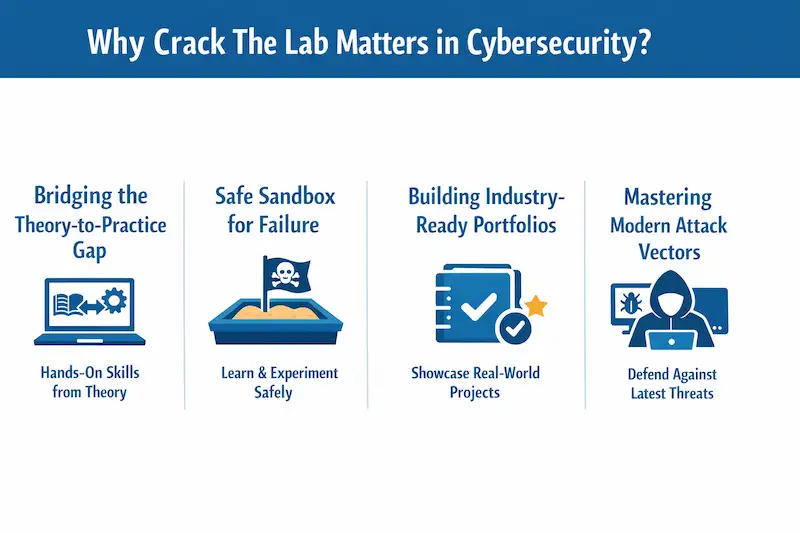
Bridging the Theory-to-Practice Gap: By requiring users to use their knowledge in real-world, simulated contexts, it goes beyond textbooks and certifications and ensures that they are capable of handling real-world technical challenges rather than only memorizing terminology.
The following are the benefits of starting your cybersecurity journey with hands-on labs:
● Accelerated Skill Acquisition: Labs allow you to learn particular tools and techniques, like network traffic analysis or vulnerability scanning, far more quickly than through passive reading by condensing years of trial-and-error into structured exercises.
● Active Threat Simulation: In contrast to traditional learning, laboratories put you in the midst of actual attack scenarios, enabling you to see how threats propagate through a system and learn how to successfully neutralize them in real time.
● Deep Technical Fluency: Direct exposure to industry-standard toolkits (such as Kali Linux, Wireshark, or Metasploit) guarantees that you are conversant with the command-line interfaces and workflows that professionals use on a regular basis.
● Confidence Through Iteration: Virtual laboratories' "reset" feature enables you to try new things and fail safely; this practice of repeated, practical iteration develops the professional confidence required to solve complicated problems without hesitation.
● Validation of Competency: Compared to a list of theoretical credentials or completed courses, successfully completing lab-based tasks offers companies tangible evidence of your problem-solving skills, which is significantly more valuable.
|
S.No. |
Topics |
Factors |
What? |
|
1. |
Theory |
Static vs. Dynamic Learning |
While practice shows how systems operate under stress, misconfiguration, or deliberate exploitation, theory gives a "snapshot" of how a system should function under ideal circumstances. |
|
Predictability vs. Chaos |
In a real-world lab or environment, variables change often, requiring you to troubleshoot unanticipated issues that weren't covered in the handbook. In contrast, textbooks provide problems with linear, predictable answers. |
||
|
2. |
Practice Gap |
Memorization vs. Muscle Memory |
You can commit the definition of a "Buffer Overflow" to memory, but you won't have the technical intuition (muscle memory) necessary for a technical position until you have personally carried out the exploit and sensed the necessary timing. |
|
Certification vs. Competency |
A certification shows that you can pass an exam, but experience shows that you can produce results. Employers frequently discover that "paper-certified" applicants find it difficult to do simple jobs due to their lack of practical command-line experience. |
The following are some of the essential skills you need before using Crack The Lab:
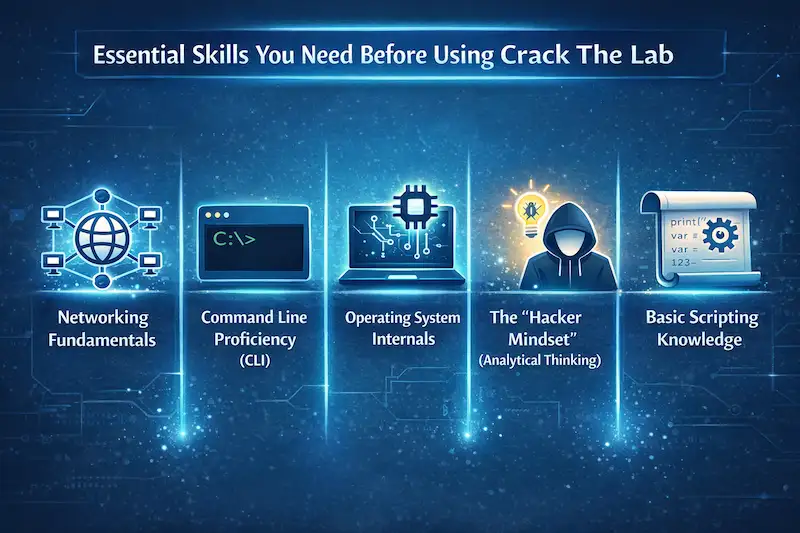
a) Networking Fundamentals: You need to be aware of how data is transferred between systems. Understanding IP addressing, the OSI model, and popular protocols like HTTP, DNS, and TCP/IP, the "roads" used by both attackers and defenders are all part of this.
b) Command Line Proficiency (CLI): The majority of labs lack a "point-and-click" interface. Using the Linux Terminal or Windows PowerShell, you should feel at ease browsing file systems, controlling permissions, and running scripts.
c) Operating System Internals: Determining if a system has been compromised or altered requires a thorough understanding of how Windows and Linux operate, particularly with regard to user roles, registry entries, and background activities.
d) The "Hacker Mindset" (Analytical Thinking): Deconstructing an issue requires more than just technical tools; it requires curiosity. You need to be able to reason about how a feature might be abused or where a developer might have made a mistake.
e) Basic Scripting Knowledge: Being able to read and edit simple Python, Bash, or PowerShell scripts will help you automate tedious operations and comprehend attack code, even if you're not a software engineer.
A contemporary computer with at least 8GB of RAM and a quad-core processor that supports virtualization programs like VMware or VirtualBox is required to run Crack The Lab efficiently. In order to safely communicate with the lab targets, your environment setup should contain a specialized "attacker" machine, usually a virtual machine running Kali Linux or Parrot OS, set up with a bridged or NAT network adapter.
|
S.No. |
Mistakes |
What? |
|
1. |
Jumping Into Advanced Tools Prematurely |
You run the danger of turning into a "script kiddie" who can execute a program but is unable to identify the underlying vulnerability that is being exploited. |
|
2. |
Chasing "Flags" Instead of Concepts |
You won't be able to comprehend the attack's rationale, which is what truly distinguishes a skilled professional, if you are solely concerned with the prize. |
|
3. |
Relying Solely on Walkthroughs |
When you follow a step-by-step instruction, you lose your ability to think critically and develop a "copy-paste" habit that doesn't work in real-world situations. |
|
4. |
Neglecting Documentation and Reporting |
It is impossible to reproduce your achievement or demonstrate your findings to a client or employer later if you don't document your steps. |
|
5. |
Expecting Immediate Mastery |
Because cybersecurity has a steep learning curve, burnout might occur before you've had the opportunity to grow if you become irritated by early setbacks. |
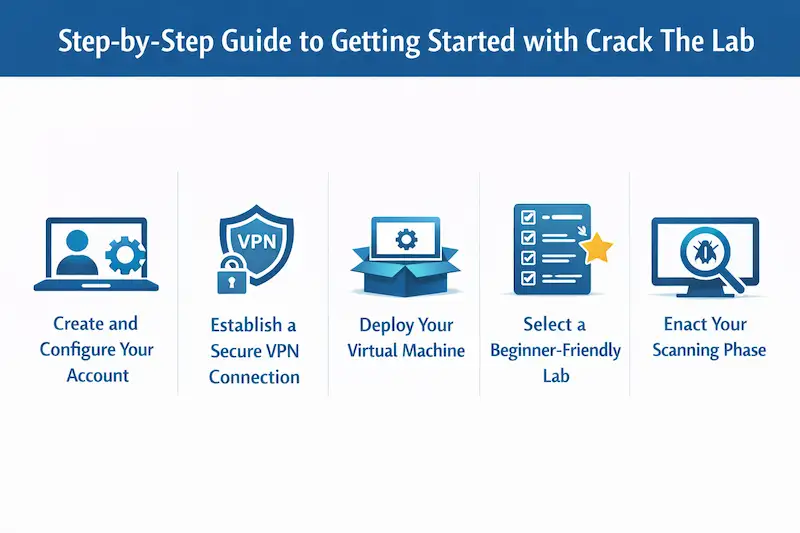
Following is the step-by-step guide to getting started with Crack The Lab:
The following are the key cybersecurity concepts you will learn:
● Vulnerability Assessment: You will discover how to methodically find, classify, and rank security flaws in programs and systems before bad actors can take advantage of them.
● Network Security Protocols: You will acquire technical knowledge of data security in transit, including how firewalls, IDS/IPS, and encryption protocols like TLS/SSL are used and configured.
● Exploitation Methodologies: You will gain a deeper understanding of the "attacker mindset" by learning the mechanics underlying popular exploits like SQL Injection, Cross-Site Scripting (XSS), and Buffer Overflows through the simulation of real-world attacks.
● Privilege Escalation: You will learn the vital significance of safe user permission management and "least privilege" principles as you follow an attacker's journey from a low-privileged account to administrator access.
● Incident Response and Logging: To identify persistent intrusions and carry out post-incident forensics, you will learn how to examine system logs and keep an eye out for questionable activity.
|
S.No. |
Practices |
What? |
|
1. |
Adopt the "One Hour" Rule |
To sustain momentum and develop deep technical expertise, dedicate at least one hour of regular lab time each day in place of lengthy, irregular study sessions. |
|
2. |
The "Three-Attempt" Strategy |
To compel your brain to perform active troubleshooting, try the problem at least three times using various logical techniques before applying a hint or walkthrough. |
|
3. |
Create Your Own "Toolbox" Repository |
Keep a local wiki or notebook, like Notion or Obsidian, where you record all of the commands, exploit syntax, and setup advice you find useful in laboratories. |
|
4. |
Emulate Real-World Red Teaming |
As you learn, put "operational security" into practice. Try to finish your challenges with as little noise as possible (e.g., by utilizing targeted scans rather than broad ones) to simulate the work of professional penetration testers. |
|
5. |
Focus on the "Why," Not Just the "How" |
Spend some time examining the patch or configuration modification that would have stopped your particular attack vector after you have successfully exploited a system. |
In the following ways, you can build a strong cybersecurity portfolio using labs:
a) Draft Detailed Write-ups: Write a technical report outlining the scope, your approach, the tools you utilized, and the final remedial procedures for each difficulty you finish.
b) Highlight the "Path to Root": In order to show that you can reason through a multi-stage attack, concentrate your documentation on how you chained exploits together or escalated access.
c) Create a Public Repository: You can showcase your investigation approach and avoid disclosing real platform solutions by hosting your sanitized write-ups and scripts on sites like GitHub or a personal blog.
d) Contextualize Your Skills: Make a clear connection between the technical actions you conducted in the lab and actual business concerns, such as how a particular SQL injection could result in a disastrous data breach.
e) Showcase Continuous Growth: To show that your knowledge is growing rather than stagnating, arrange your portfolio chronologically or according to a "skill tree" (e.g., Network Security, Web App Hacking).
The following are the next steps after completing your first cybersecurity challenges:
1. How do I start my cybersecurity journey?
In the following ways, you can start your cybersecurity journey:
a) Master the Foundational "Bedrock",
b) Prioritize Hands-On Practice,
c) Develop an Analytical "Hacker Mindset",
d) Build a Tangible Portfolio, and
e) Align with Industry Standards.
2. What is the 80 20 rule in cybersecurity?
Prioritized patching and basic "cyber hygiene" are the best defenses, according to the 80/20 rule in cybersecurity, often known as the Pareto Principle, which states that about 80% of security breaches are caused by the 20% of most prevalent and avoidable vulnerabilities.
3. Where should a beginner start in cybersecurity?
You can get in touch with Craw Security, which offers a specialized cybersecurity training program, if you wish to begin your career in cybersecurity as a novice.
4. How to start a cybersecurity startup?
In the following ways, you can start a cybersecurity startup:
a) Solve a "Net-New" Problem or Compliance Gap,
b) Shift from POC to Proof of Value (POV),
c) Build for Integration and Automation,
d) Translate Security ROI into Business Terms,
e) Secure Credibility Through Rigor.
5. hat are the 7 types of cybersecurity?
The following are the 7 types of cybersecurity:
a) Network Security.
b) Application Security,
c) Information (Data) Security,
d) Cloud Security,
e) Endpoint Security,
f) Identity and Access Management (IAM), and
g) Disaster Recovery and Business Continuity.
6. Is cybersecurity a 9-to-5 job?
Cybersecurity is usually an on-call, high-stakes career where incident response, threat hunting, and important system maintenance frequently require irregular hours or weekend support, whereas many administrative or GRC tasks adhere to regular work hours.
7. Is 25 too late for cybersecurity?
No, 25 is the perfect age to start working in the sector since you have the maturity to understand complicated systems and the career trajectory to succeed in a high-demand, quickly changing industry.
8. What is 90% of cyber attacks?
Human error or conduct, such as falling for phishing scams, using weak passwords, or improperly configuring security settings, is responsible for about 90% of cyberattacks.
9. What is L1, L2, L3 SOC analyst?
L2 analysts investigate escalated alerts in greater detail, L3 analysts manage advanced threat hunting, forensics, and complicated incident remediation, while L1 analysts handle initial triage and basic monitoring.
Now that we have talked about Crack The Lab, you might want to get your hands on it. For that, you can get in contact with Craw Security, offering this amazing catch the flag platform to IT Aspirants with a better learning experience.
At this platform, practitioners will be able to test their knowledge on the playground while defending against fire malware. What are you waiting for? Contact, Now!
Trending Blogs