Cyber Security
10 Best Pentesting Tools to Strengthen Your Cybersecurity in 2026
Pawan PanwarApr 14, 2026
Preparing your workspace...
Loading latest data
Loading article...
Preparing blog content
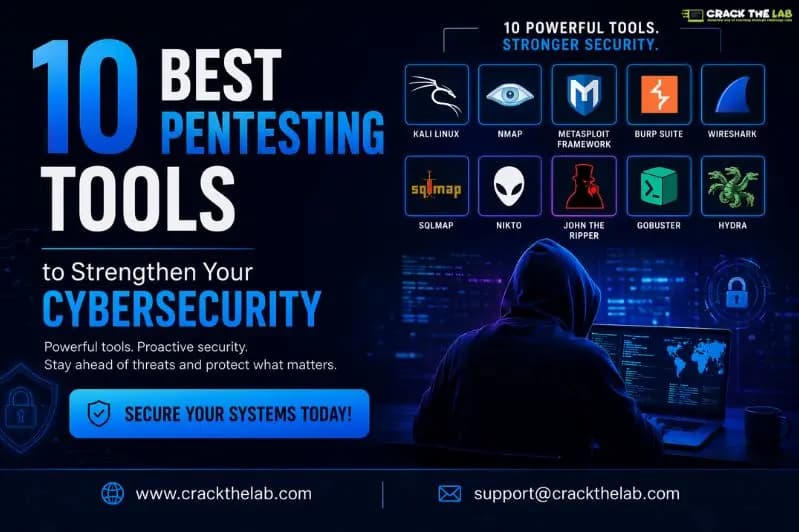
Let’s take a look at the Best Pentesting Tools and learn how they work for the protection of your systems and databases against online threats! Several organizations use such tools to improve their security measures after identifying loopholes in their current security practices.
Moreover, we will introduce you to a Catch the Flag platform where you can practice your cybersecurity skills against other teams. What are we waiting for? Let’s get started!
Cybersecurity experts employ pentesting tools, which are specialized software programs or frameworks, to find, test, and exploit vulnerabilities in digital environments. These technologies assess the efficacy of an organization's security posture by simulating controlled real-world cyberattacks.
They offer actionable insights to assist teams in patching vulnerabilities before real hostile actors can take advantage of them by automating operations like network scanning, password cracking, or code analysis.
Let’s take a look at the Best Pentesting Tools and how these tools help you in protecting your working environment against online threats!
|
S.No. |
Phases |
What? |
|
1. |
Reconnaissance & Planning |
Obtaining information about the target and establishing the parameters and objectives of the test. |
|
2. |
Scanning |
Identifying open ports, services, and any security holes in the target network or application using automated technologies. |
|
3. |
Gaining Access |
Imitating a real-world breach by taking advantage of vulnerabilities found to get beyond security measures and gain access to the system. |
|
4. |
Maintaining Access |
Establishing a long-term presence to assess the extent of the danger and the possibility of data exfiltration. |
|
5. |
Analysis & Reporting |
Creating a thorough log of vulnerabilities discovered, the dangers they present, and particular repair suggestions. |
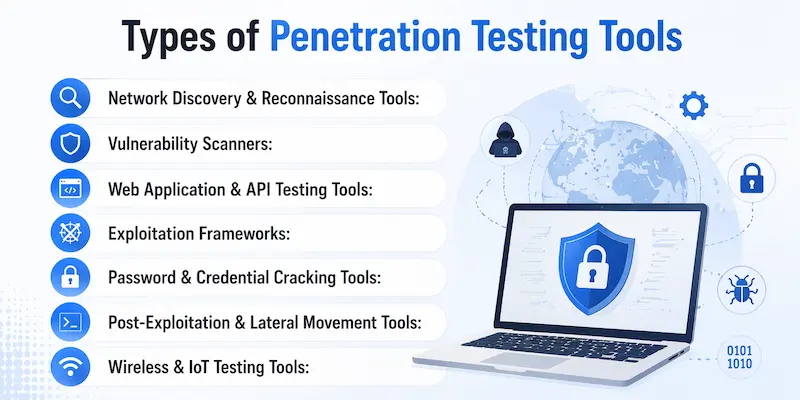
The following are the types of penetration testing tools:
The following are the Top 10 Best Pentesting Tools for Experts in 2026:
● ZeroThreat: Using autonomous agents, an AI-powered DAST platform can safely exploit and evaluate over 100,000 attack pathways with almost no false positives.
● Kali Linux: The industry-standard operating system includes more than 600 specialized tools for digital forensics, exploitation, and reconnaissance.
● Nmap: The crucial "Network Mapper" for service fingerprinting, port scanning, and host discovery using its potent Scripting Engine (NSE).
● Metasploit: A top-notch framework for creating, testing, and running exploits against distant targets.
● SQLmap: An open-source powerhouse that takes over database servers by automating the process of finding and exploiting SQL injection vulnerabilities.
● Burp Suite: With a large BApp store for expert extensions, this is the best intercepting proxy for manual web application testing.
● OWASP ZAP: An adaptable, developer-friendly intercepting proxy that performs exceptionally well in CI/CD pipelines' automatic baseline security testing.
● w3af: A thorough framework for web application attacks and audits that connects automated scanning with controlled exploitation.
● Nikto: A fast web server scanner that finds specific server misconfigurations, out-of-date server software, and harmful files.
● Nessus: The industry standard for vulnerability assessment, including enterprise fleets compliance-mapped reporting and deep configuration auditing.
By employing autonomous agents to carry out rapid reconnaissance and spot intricate vulnerability chains that conventional scanners overlook, AI-powered offensive security products are completely changing the threat environment.
These technologies provide continuous, large-scale security validation that changes as fast as contemporary software environments by imitating human intuition to modify their exploitation strategies in real-time.
The following are the pentesting tools for cloud-native and API environments:
a) ZeroThreat: An AI-driven DAST solution that specializes in finding hidden vulnerabilities in cloud apps and complex APIs without the need for manual scripts.
b) TruffleHog: A fast scanner that searches cloud storage and git repositories for sensitive credentials, keys, and disclosed secrets.
c) Postman & Newman: Essential tools for both automatic and manual API testing that let security experts intercept, alter, and replay requests to identify logical errors.
d) Pacu: An open-source AWS exploitation tool for escalating privileges in compromised environments and testing cloud configuration security.
e) Kube-bench: A customized tool that ensures cloud-native clusters are set in accordance with best practices by comparing Kubernetes deployments to the CIS Benchmark.
In the following ways, you can choose the right tool to automate your penetration testing:
|
S.No. |
Factors |
Why? |
|
1. |
Lack of Business Logic Context |
Automated systems find it difficult to comprehend the unique regulations of your company and are unable to identify defects, such as the ability to modify pricing in a shopping cart. |
|
2. |
The "False Positive" Fatigue |
When security teams rely too much on tools, they may be overwhelmed with thousands of pointless alarms, which could cause real risks to be missed or disregarded. |
|
3. |
Inability to Perform Creative Chaining |
While human attackers combine several "low-risk" bugs to produce a high-impact exploit, tools frequently perceive vulnerabilities in isolation. |
|
4. |
False Sense of Security |
Although passing an automated scan offers a "snapshot" in time, it does not ensure protection from complex, persistent threats that change every day. |
|
5. |
Compliance vs. Real Security |
Your data is not protected just because you checked a box for an audit; technologies frequently put regulatory checklists ahead of identifying the real routes an attacker might take. |
Just register your target domain or API endpoint to start penetration testing with ZeroThreat. This will enable the self-governing AI agents to map your attack surface and find intricate vulnerability chains.
Once set up, you can start scheduled or on-demand scans that validate exploits in real time and provide actionable repair steps from within your current DevSecOps process.
In order to identify and rank threats in real time, CTEM integration entails integrating automated validation tools and continuous monitoring directly into the security lifecycle. Organizations can transition from reactive patching to a proactive, risk-based security posture by coordinating automated testing with the five phases of the CTEM framework: scoping, discovery, prioritization, validation, and mobilization.
About Best Pentesting Tools
1. What are the different types of pentesting tools?
The following are the different types of pentesting tools:
a) Network Discovery & Reconnaissance Tools,
b) Vulnerability Scanners,
c) Web Application & API Testing Tools,
d) Exploitation Frameworks,
e) Password & Credential Cracking Tools,
f) Post-Exploitation & Lateral Movement Tools, and
g) Wireless & IoT Testing Tools.
2. How do I choose the right pentesting tool for my project?
In the following ways, you can choose the right pentesting tool for your project:
a) Prioritize Exploit Validation over Scanning,
b) Evaluate "Code-to-Runtime" Context,
c) Verify API and Cloud-Native Coverage,
d) Assess CI/CD Pipeline Integration, and
e) Demand Actionable, Audit-Ready Reporting.
3. What are the most popular pentesting tools in 2026?
The following are the most popular pentesting tools in 2026:
a) ZeroThreat,
b) Kali Linux,
c) Nmap,
d) Metasploit, and
e) SQLmap.
4. Are open-source pentesting tools as effective as paid ones?
While premium products frequently offer better automation, integrated reporting, and specialized support for enterprise-scale setups, open-source technologies offer a great deal of flexibility and community-driven innovation
5. Can pentesting tools be used for continuous security testing?
Yes, continuous security testing may be carried out by integrating contemporary pentesting tools into CI/CD pipelines, guaranteeing that each code modification is automatically checked for vulnerabilities.
6. Do I need coding skills to use pentesting tools effectively?
Although many automated tools have point-and-click interfaces, customizing exploits, automating tedious operations, and deciphering complicated scan findings require a basic understanding of programming languages like Python or Bash.
7. How often should penetration testing be conducted?
Although high-risk environments benefit from ongoing, automated validation, penetration testing should be carried out at least once a year or anytime major modifications are made to your infrastructure.
8. Which pentesting tools offer API testing capabilities?
Burp Suite, OWASP ZAP, Postman, and AI-driven platforms like ZeroThreat, which automate the identification and exploitation of weak authentication and logic problems, are major pentesting tools with API testing capabilities.
9. What’s the difference between vulnerability scanners and penetration testing tools?While penetration testing tools are made to actively attack known security holes to show real-world impact and risk, vulnerability scanners concentrate on finding and listing known security issues and missing patches.
Now that we have talked about the Best Pentesting Tools, you might want to test your cybersecurity knowledge & skills while using such tools. For that, you can go for an amazing platform, “Crack The Lab’ a dedicated Catch The Flag platform.
There, you will be able to use your cybersecurity techniques and skills to fight against fire malware. What are you waiting for? Contact, Now!
You May Also Like