Red Teaming
Advanced Red Team Attack Techniques Used by Ethical Hackers
Pawan PanwarApr 24, 2026
Preparing your workspace...
Loading latest data
Loading article...
Preparing blog content
Let’s talk about what Advanced Red Team Attack Techniques are and see how they are used by practitioners in Red Team. We will explain what Red Team Attacks are and how you can protect yourself against such attacks.
Moreover, we will introduce you to a reliable Catch The Flag platform offered by a reputable VAPT service provider. What are we waiting for? Let’s get straight to the topic!
Advanced red team operations employ complex supply chain compromises to obtain persistent, high-privilege access in hardened environments, evasive living-off-the-land (LotL) binaries to evade signature-based detection, and adversary emulation to mimic particular threat actor TTPs.
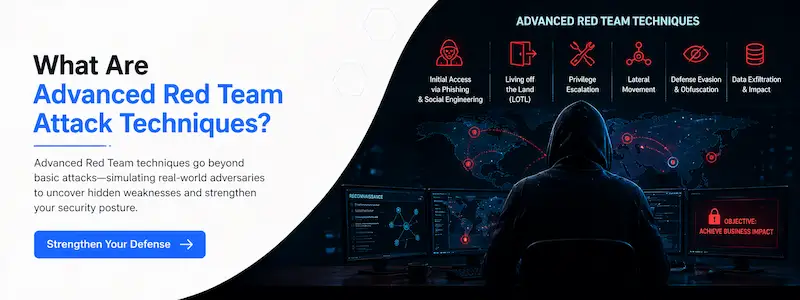
These engagements actively test an organization's detection and response capabilities against realistic, multi-stage kill chain scenarios, with a focus on credential harvesting and covert lateral movement.
These teams find important security flaws that conventional automated scanning methods frequently miss by modeling advanced persistent threats. Let’s take a look at the Advanced Red Team Attack Techniques and learn how they are used!
|
S.No. |
Topics |
Factors |
What? |
|
1. |
Red Teaming |
Scope & Objective |
Aims to evaluate an organization's detection and response capabilities against a simulated, sophisticated attacker by using a goal-oriented methodology instead of a broad vulnerability search. |
|
Methodology |
Uses covert tactics, methods, and procedures (TTPs) throughout the whole organization to accomplish a certain goal, including gaining access to confidential information or intellectual property. |
||
|
Outcome |
Assesses the efficiency of the personnel, procedures, and technology used in security operations, offering information about how well the company can identify and handle a real-world breach. |
||
|
2. |
Penetration Testing |
Scope & Objective |
Focuses on finding and recording as many vulnerabilities as possible inside a predetermined scope, like a single server, network, or application. |
|
Methodology |
Uses a methodical, structured technique (typically based on compliance frameworks) to identify technical defects such as software bugs, misconfigurations, or missing patches. |
||
|
Outcome |
Provides a thorough report outlining vulnerabilities found, their seriousness, and detailed repair suggestions to strengthen the overall technical security posture. |
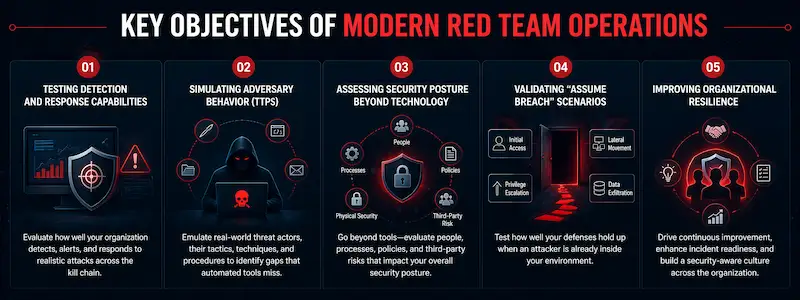
The following are the key objectives of modern red team operations:
The following are the initial access techniques used by red teams:
● Phishing (T1566): Uses social engineering in emails or messages to deceive users into giving credentials or running malicious programs.
● Exploiting Public-Facing Applications (T1190): Aims to obtain unauthorized execution access by exploiting flaws in software or services that are available over the internet.
● Valid Accounts (T1078): Uses credentials that have been compromised or obtained legally to blend in with authorized user activity.
● Supply Chain Compromise (T1195): Creates a foothold by manipulating third-party hardware, software, or services before they arrive at the target.
● Drive-by Compromise (T1189): Compromises websites that are commonly visited in order to infect their systems or browsers automatically when they load.
● Physical/ Hardware Access: Involves accessing network ports or plugging in malicious USBs in order to have a direct connection with on-premises equipment.
|
S.No. |
Factors |
What? |
|
1. |
Exploiting Vulnerable Software & Kernels |
Uses kernel-level vulnerabilities or unpatched local software bugs to raise restricted user rights to root or SYSTEM level. |
|
2. |
Abusing Misconfigurations |
Gains unlawful administrative authority by taking advantage of weak file permissions, unsafe service configurations, or overly permissive environment variables. |
|
3. |
Credential Harvesting & Replay |
Takes session tokens, hashes, or cleartext passwords out of files or memory to pose as more privileged users on the network. |
|
4. |
Token & Process Manipulation |
Assumes the identity of a privileged account by stealing authentication tokens from ongoing sessions or inserting malicious code into high-integrity processes. |
|
5. |
Abusing Scheduled Tasks & Services |
Builds or modifies malicious service binaries and background jobs that run with elevated rights when the system is started, or certain events are triggered. |
The following are some lateral movement techniques inside target networks:
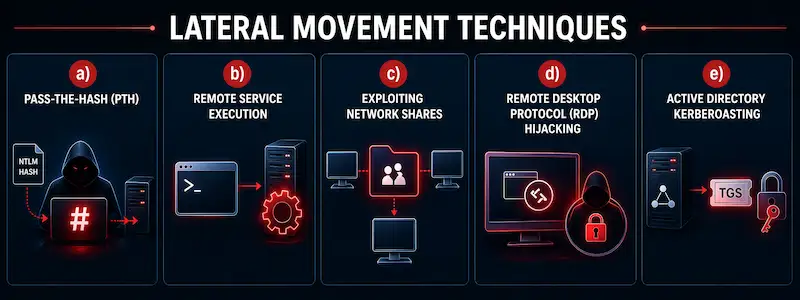
a) Pass-the-Hash (PtH): Uses Kerberos tickets or recorded NTLM hashes to authenticate to other systems without requiring the user's real cleartext password.
b) Remote Service Execution: Uses programs like PsExec, WMI, or WinRM to remotely execute commands or malicious malware on target computers over a network.
c) Exploiting Network Shares: Accesses sensitive or administrative file shares in order to steal credentials, scripts, or configuration files that allow for additional mobility.
d) Remote Desktop Protocol (RDP) Hijacking: Interactively logs into distant systems using pre-existing RDP sessions or credentials that have been stolen, posing as an authorized user.
e) Active Directory Kerberoasting: Asks the Domain Controller for service tickets for particular service accounts in order to crack them offline and obtain high-privileged access to other network segments.
The following are some command and control (C2) evasion techniques:
By inserting malicious code into legitimate system processes or launch services, red teamers are able to maintain long-term access, making sure their presence endures reboots and credential resets.
These covert persistence techniques usually entail changing WMI event subscriptions, using DLL side-loading, or setting up hidden scheduled tasks that minimize behavioral footprints and occasionally broadcast back to command-and-control infrastructure.
In order to get over Data Loss Prevention (DLP) filters, red teams encrypt and compress important files before tunneling the data to external servers via trustworthy protocols like HTTPS or DNS.
They may employ "low and slow" transfers, using steganography or broken data chunks dispersed over extended periods of time to mix in with approved network activity in order to further avoid detection.
The following are some of the tools commonly used in advanced red team attacks:
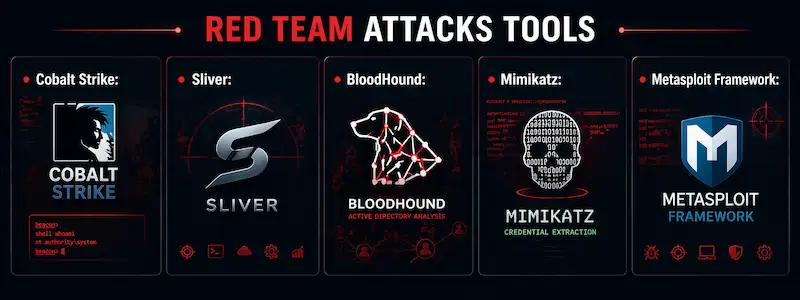
● Cobalt Strike: An industry-standard commercial framework for managing C2 infrastructure, simulating complex adversary behaviors, and post-exploitation tasks.
● Sliver: An extremely flexible adversary emulation system that is open-source and supports cross-platform operations and multi-transport implants for adaptable red teaming.
● BloodHound: An indispensable tool for examining and visualizing Active Directory installations to spot intricate attack routes, configuration errors, and chances for privilege escalation.
● Mimikatz: An effective post-exploitation tool that helps with credential harvesting and lateral movement by extracting hashes, Kerberos tickets, and plain-text passwords from memory.
● Metasploit Framework: A fundamental platform for penetration testing and exploit creation that automates vulnerability discovery, exploitation, and validation across target systems.
Red teaming technologies are used to simulate actual cyberattacks in order to find security flaws, test detection skills, and confirm an organization's capacity to counter persistent, sophisticated threats.
While a SOC enables continuous, real-time monitoring and incident response to manage active threats, VAPT offers a periodic assessment of vulnerabilities to build your security; neither is intrinsically superior.
Red team assaults are controlled, adversarial simulations created to assess an organization's security by imitating the strategies, tactics, and procedures of actual attackers in order to find weaknesses in personnel, procedures, and technology.
The following are the 4 phases of an attack:
a) Reconnaissance and Planning,
b) Initial Access and Persistence,
c) Lateral Movement and Escalation, and
d) Exfiltration and Impact.
The following are the common red team tactics:
a) Stealthy Reconnaissance,
b) Social Engineering,
c) Adversary Emulation,
d) Living-off-the-Land (LotL), and
e) Lateral Movement & Credential Harvesting.
The following are the techniques of red teaming:
a) Targeted Adversary Emulation,
b) Covert Command and Control (C2) Development,
c) Stealthy Post-Exploitation,
d) Advanced Lateral Movement, and
e) Social Engineering & Physical Intrusion.
Red team attacks are designed to test an organization's detection and response capabilities against a simulated, sophisticated adversary. They follow a strategic lifecycle of reconnaissance, initial access, persistence, lateral movement, and data exfiltration.
The following are some tools used for red teaming:
a) Cobalt Strike,
b) Sliver,
c) BloodHound,
d) Mimikatz, and
e) Metasploit Framework.
The following are the most commonly used techniques by hackers:
a) Phishing (T1566),
b) Use of Valid Accounts (T1078),
c) Exploiting Public-Facing Applications (T1190),
d) Credential Harvesting, and
e) Abuse of Trusted Relationships (Supply Chain).
Now that we have talked about the Advanced Red Team Attack Techniques, you might want to test your own cybersecurity skills against red team attacks. For that, you can go for Crack The Lab, a dedicated Catch The Flag platform offered by Craw Security.
Moreover, on this platform, the practitioners can fight against fire malware with their cybersecurity knowledge & skills and try to protect their territory against the blue team. What are you waiting for? Contact, Now!